
Floor Graphics in Boston: Materials, Slip Ratings and How Long They Last

A floor graphic is the only piece of print in a building that people walk on. That one fact decides how it has to be built: which face film, which overlaminate, which adhesive, and whether it gets cut to a shape or left square. Everything else — the artwork, the color, the size — comes after.
This guide covers what a printed floor graphic has to survive, the slip-resistance specification worth asking for by name before anyone approves artwork, and the production limits at Albert Basse Associates in Stoughton, Massachusetts that decide how large a single-piece floor graphic can be and what shape it can take.
Key Takeaways
- Slip resistance is a material specification, not a printing one. It comes from the overlaminate on the media. Ask for the wet DCOF figure under ANSI A326.3 in writing before the art is approved, because no printer can add it afterward.
- The floor decides the material. Sealed concrete, VCT, polished stone, textured concrete and carpet each take a different media. Name the surface when you ask for a quote and send a photograph of it.
- Size is settled by the cutting table, not the press. Our Zünd table works to 60 by 120 inches, and that is the practical ceiling for a floor graphic produced in one piece.
- Shape is a file question on short runs and a tooling question on long ones. The Zünd contour-cuts any outline straight from the artwork. A long repeat run can move to the Thompson die press instead.
- A large identical run may belong on the screen line. The five-color SVECIA press takes sheets to 82 by 62 inches at up to 500 sheets per hour and lays flat spot PMS color.
What a floor graphic has to survive
A wall graphic is looked at. A floor graphic is stepped on, pushed over with a loaded shopping cart, ground with the grit people carry in on their shoes, and wetted every winter day in New England with snowmelt and road salt. Then it is cleaned, often with a ride-on scrubber dragging an abrasive pad across it.
None of that wear lands on the ink. It lands on the protective overlaminate above the ink, which is the component that is actually doing the work. When a floor graphic fails early it is almost never because the print faded. It is because the laminate wore through at the traffic line, or the adhesive let go at an edge and the corner started lifting.
So the useful question is not how long the print lasts. It is how long that laminate lasts under your traffic. Albert Basse publishes two to three years of outdoor durability on its digital printing, and five years with a protective laminate. Those figures describe weathering — sun, rain, freeze and thaw. They do not describe footfall, and a graphic in a supermarket entrance will not see anything like that life. Ask for the media manufacturer’s stated service life for a floor application specifically.
Slip resistance is the specification to ask for by name
The current test method used in the United States is ANSI A326.3. It measures dynamic coefficient of friction with a tribometer and reports it wet, which is the condition that matters: a dry floor graphic is rarely the problem, and a wet one at an entrance in February is. The number commonly cited as the floor for a level interior walkway is a wet DCOF of 0.42 or above.
You will still see UL 410 quoted on floor graphic media. It is a static test, and trade coverage of floor graphics has been consistent that a static figure says very little about a person walking across the surface. If a data sheet offers only UL 410, that is a reason to ask for the ANSI A326.3 result as well.
Responsibility for that testing sits with the company that manufactures the media, not with the printer putting ink on it. Which is exactly why it belongs in your purchase order: ask for the test report for the specific product being quoted, and get it before the artwork is approved rather than after the graphics are on the floor.
The floor decides the material, not the artwork
Adhesion is a surface problem. The same printed film that holds for a year on sealed concrete can fail in a week on the wrong floor, and no amount of pressure at installation fixes it.
- Smooth and sealed — sealed concrete, VCT, polished stone and vinyl plank are the straightforward case, and take a conventional floor film with a floor-rated overlaminate.
- Textured or profiled — broom-finished concrete, quarry tile, brick pavers and anything with a grout line need a conformable media that can be worked down into the profile. A standard film bridges the texture, traps air, and lifts at the first cart wheel.
- Carpet — a different product entirely, with a mechanical adhesive system made to grip pile. Standard vinyl does not stay on carpet.
- Exterior — a sidewalk or an entry apron adds freeze and thaw, plow damage and salt on top of the traffic, and should be specified as an outdoor application from the start.
Two more conditions decide the job before anything is printed. The floor has to be clean and dry, degreased rather than just swept. And it has to be fully cured — new concrete and newly applied epoxy or sealer need their stated cure time before anything is stuck to them, which is a question for the flooring contractor, not the printer.
Send a photograph of the actual floor with the quote request. It takes a minute and it settles the material question in one pass.
What our plant can print and cut
Printing, screen printing and finishing all sit in the same building in Stoughton, so the limits that decide a floor graphic’s size are these ones rather than a chain of vendors. The cutting table is usually the binding constraint, not the press.
Production limits
The numbers that bound a floor graphic job
Printing width is rarely what stops a floor graphic. Cutting and laminating width usually is.
60 × 120 in
Zünd iCut router and cutting table — the single-piece ceiling
60 in
Laminating and mounting width, which sets the protected width
3.5 m
Durst P5 350/HS print width, roll or board
37 × 55 in
Custom die cutting, with larger sizes as a job needs them
720 DPI
Photo-realistic digital output, with white and clear ink available
Equipment and output specifications published by Albert Basse Associates, Stoughton, MA.
A floor graphic wider than 60 inches can still be printed, but it stops being one piece. Beyond the laminating width it becomes panels butted on site, and a seam on a floor is a seam under a cart wheel, so it is worth designing around rather than discovering at install. Roll work is slit on the 64-inch Futoba, and rigid pieces route on the Zünd L2500.
Cut to shape, or left rectangular
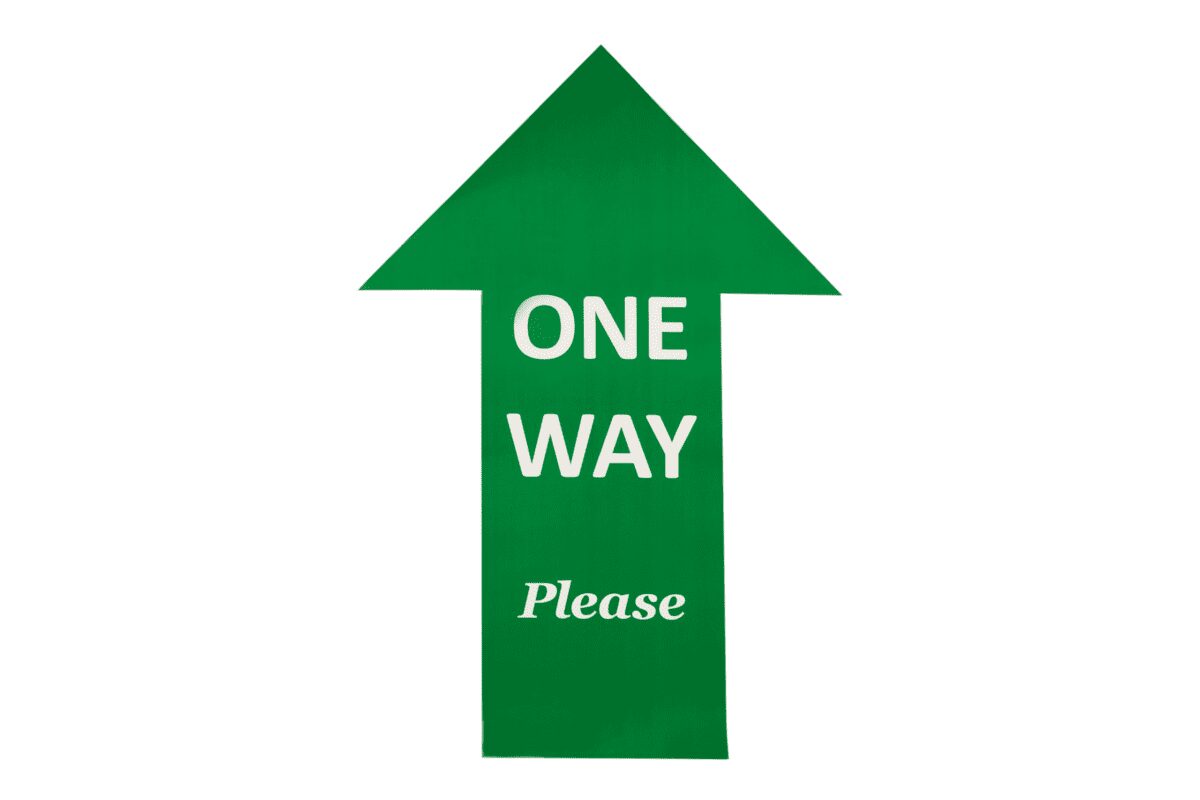
Floor graphics are one of the few print products where the shape carries the message. A directional arrow reads as an instruction. A circle reads as a place to stand. A rectangle reads as a poster someone dropped.
Cutting to shape is a file question on most jobs. The Zünd follows a cut path drawn in the artwork, so any outline you can draw can be cut, and a short run of one-off shapes costs no tooling. On a long repeat run — the same shape across dozens of stores, reordered each season — the finishing department can move the job to the Thompson die press instead, where custom die cutting runs to 37 by 55 inches and larger when the piece needs it.
One detail worth specifying either way: round the corners. A square corner is the first edge a cart wheel or a mop catches, and a lifted corner is how most floor graphics start failing.
When a floor graphic rollout becomes a screen printing job
Most floor graphics print digitally, because most are photographic, short-run or different in every location. A seasonal promotion across a chain is a different shape of job: hundreds or thousands of identical pieces, two or three flat brand colors, no photography.
That is the case the screen line was built for. The SVECIA SAM X five-color UV inline press takes sheets up to 82 by 62 inches at speeds up to 500 sheets per hour, every screen press here lays spot PMS colors, and the UV ink range includes clear coats and varnish. A spot color mixed as ink is more consistent across a long run than the same color built from process inks, which matters when the graphic carries a brand color onto the floor of every store. Our guide to screen printing versus digital printing covers where the crossover sits.
Designing a floor graphic that actually gets read
A floor graphic is read while moving, from several feet away, at an angle no designer ever previews it at. That makes it the least forgiving surface in a store for anything subtle.
Keep it to one idea and a handful of words. Set the type large and at high contrast against the graphic’s own background rather than against the floor, since you cannot control what the floor looks like after a wet morning. Avoid fine detail and thin strokes near the edges, which is where cutting tolerance and foot wear both show first. And check the piece at its real size on the ground before approving it, not at a hundred percent on a monitor.
If the brand color has to be exact, say so at the quote stage. Our prepress and design department proofs on an Epson Stylus Pro 9900 to produce a color-accurate contract proof before the run starts, which is the point at which a color disagreement is still cheap.
Installation, cleaning and removal
Install onto a clean, dry, degreased floor that has finished curing. Work from the center out so air has somewhere to go, and press the edges down firmly, because the edge is the whole battle.
For cleaning, a damp mop is fine. Harsh solvents attack the laminate, and a scrubber’s abrasive pad will wear a traffic line through a graphic faster than feet will. If the building uses a ride-on machine, tell the cleaning contractor the graphic is there.
For removal, ask the media manufacturer for the stated removal window on the product being quoted. Adhesives build strength over time and in heat, and a film left down well past its intended life is the one that comes up in pieces. If the graphic is promotional, put the swap date in the same schedule as the artwork.
Frequently asked questions
How long does a floor graphic last?
Less time than the same print on a wall, and the deciding factors are the traffic over it and the overlaminate above the ink rather than the ink itself. The two to three years of outdoor durability Albert Basse publishes for digital prints, or five years with a laminate, describes weathering rather than footfall. For a floor application, ask for the media manufacturer’s stated service life for that use.
Are floor graphics slip resistant?
Only if the media was built and tested to be. Slip resistance comes from the overlaminate, and the figure to ask for is the wet dynamic coefficient of friction under ANSI A326.3, where 0.42 is commonly cited as the minimum for a level interior walkway. Request the test report for the specific product before artwork is approved.
How big can a single floor graphic be?
In one piece, the practical ceiling is the Zünd cutting table at 60 by 120 inches, and the laminating width of 60 inches sets how wide a protected piece can be. Anything larger is produced as panels and butted on site. Our large format printing process guide explains how a large graphic moves through the plant.
Can floor graphics be cut to a custom shape?
Yes. The Zünd contour-cuts whatever outline is drawn in the artwork file, with no tooling cost, so arrows, footprints, circles and logo shapes are all straightforward. For a long repeat run, custom die cutting runs to 37 by 55 inches and larger as needed.
Will a floor graphic stick to carpet?
Only with a carpet-specific media, which uses a different adhesive system designed to grip pile. Standard floor vinyl will not hold. Name the surface when you request the quote so the right product is priced from the start.
Can the same artwork run as a floor graphic, a window graphic and a wall graphic?
Yes, and it is a common way to tie a campaign together. The file is the same; the media, the laminate and the adhesive change for each surface. See our guides to window graphics, wall coverings and custom decals, or the overview of environmental graphics for how the pieces work together in one space.
Do floor graphics work for directions and wayfinding?
They do, and a floor is often the only clear sightline in a crowded space. Wayfinding is a planning exercise before it is a printing one, and our guide to signage for better wayfinding covers how to lay out a route.
Get a floor graphic specified for your floor
Albert Basse Associates has printed in Massachusetts since 1928, and runs digital printing, screen printing, prepress and finishing together in a 35,000-square-foot plant at 175 Campanelli Parkway in Stoughton, just south of Boston. For a multi-site program, finished graphics drop ship nationwide through UPS and FedEx from the same building.
Send four things and the quote comes back specified rather than generic: the floor surface, the finished size, the quantity, and how long the graphic has to stay down. Call (781) 344-3555 or request a quote, and the team responds within 24 hours. You can also browse the full range of print products produced here.