
Grocery Store Signage in Boston: Formats, Materials and Reorders

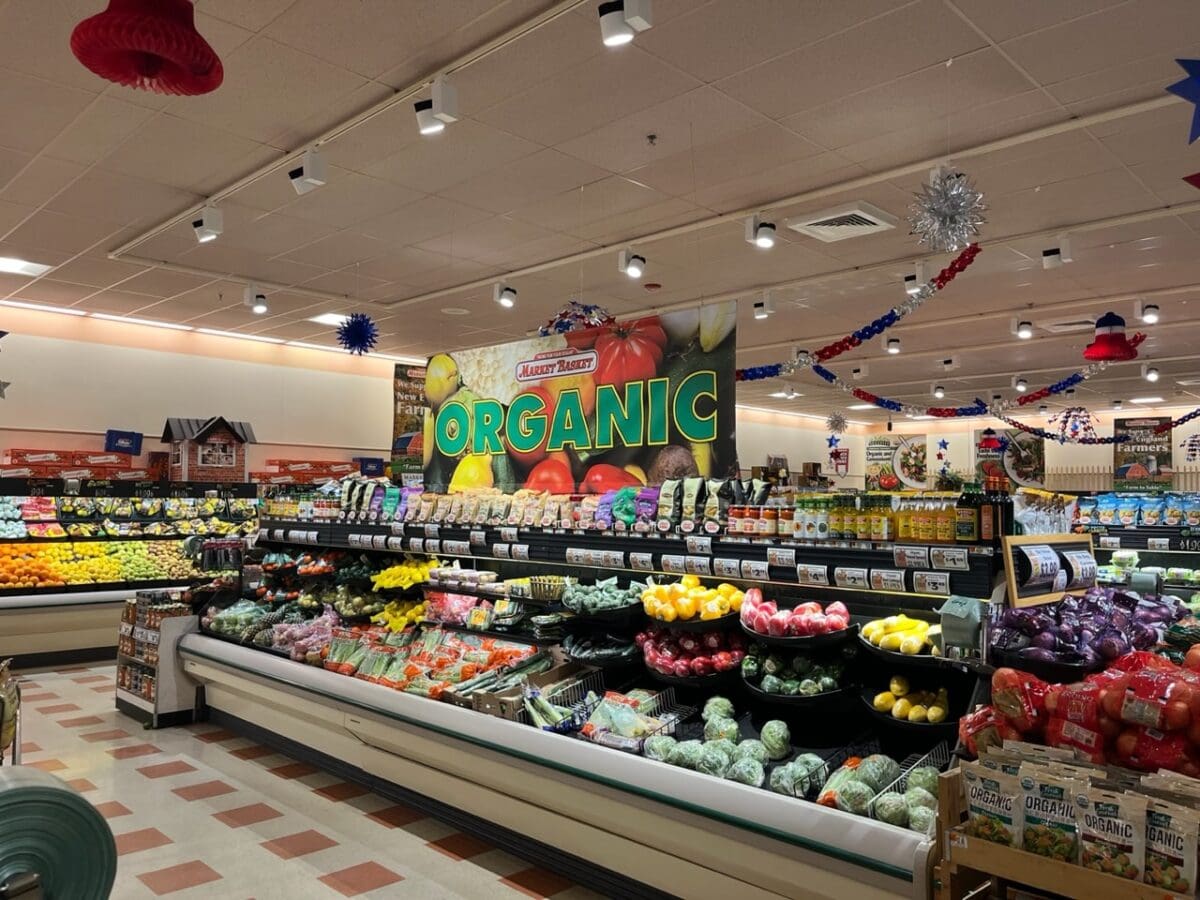
A supermarket is not one place to put a sign. It is five, and they do not share a specification. The produce case is wet and cold. The frozen aisle runs condensation down anything you stick to it. Bakery and deli counters get wiped with sanitizer several times a day. Center-store aisles are dry and warm. The front windows take full sun and street grime.
Most grocery signage that fails did not fail at the press. It failed because one material was ordered for all five environments. This guide covers which sign belongs in which department, the two conditions that account for most of the failures, what we print grocery graphics on in Stoughton, Massachusetts, and how a chain reorders the same sign next season and gets the same color back.
Key Takeaways
- Specify by department, not by store. A produce sign, a freezer door cling and a center-aisle header card are three different material decisions. Quoting one material for the whole store is what produces curling edges and faded headers by month three.
- Cold and wet surfaces defeat ordinary adhesive. A pressure-sensitive adhesive applied to a cold, damp case will not key to it. Ask your media supplier in writing for a cold-apply or low-temperature adhesive rating before artwork is approved, because no printer can add that afterward.
- Cleaning is a specification. Anything within arm’s reach of food gets wiped with sanitizer. Unprotected digital ink does not survive that. A laminate or a UV clear coat is the difference between one season and several.
- Quantity decides the press, not the look. A seasonal promotion across a handful of stores runs digitally. The same sign repeated across every store in a chain, in flat brand color, usually belongs on the screen line.
- Plan the reorder with the first order. Grocery signage is a program, not a project. Lock the color on a contract proof once, and the next run matches it rather than approximating it.
One store, five print environments
Grocery is the hardest retail setting print has to live in. A clothing store is one dry, climate-controlled room. A supermarket is a building where parts of the floor are refrigerated, parts are misted with water on a timer, parts are cleaned with chemicals every shift, and parts are exposed to weather through the glass.
Treat it as five environments and the material questions answer themselves:
- Produce. Water, misting, and cold air. Surfaces are often wet when a sign is installed.
- Refrigerated and frozen cases. Cold glass and metal, and condensation on both sides of the door.
- Service counters: bakery, deli, butcher, prepared foods. Grease in the air, and frequent sanitizer contact.
- Center store. Dry, warm, high traffic. The easiest environment and the largest sign count.
- Front end and perimeter. Checkout, entry doors, and windows. Sun through the glass, and public contact.
The same promotion often needs a sign in all five. That is one artwork file and up to five material specifications.
Which department takes which sign
This is the part worth settling before anyone designs anything, because it determines what gets quoted.
Specify by department
What to ask for, department by department
One artwork file, five material decisions. These are the questions to put in the quote request.
Produce
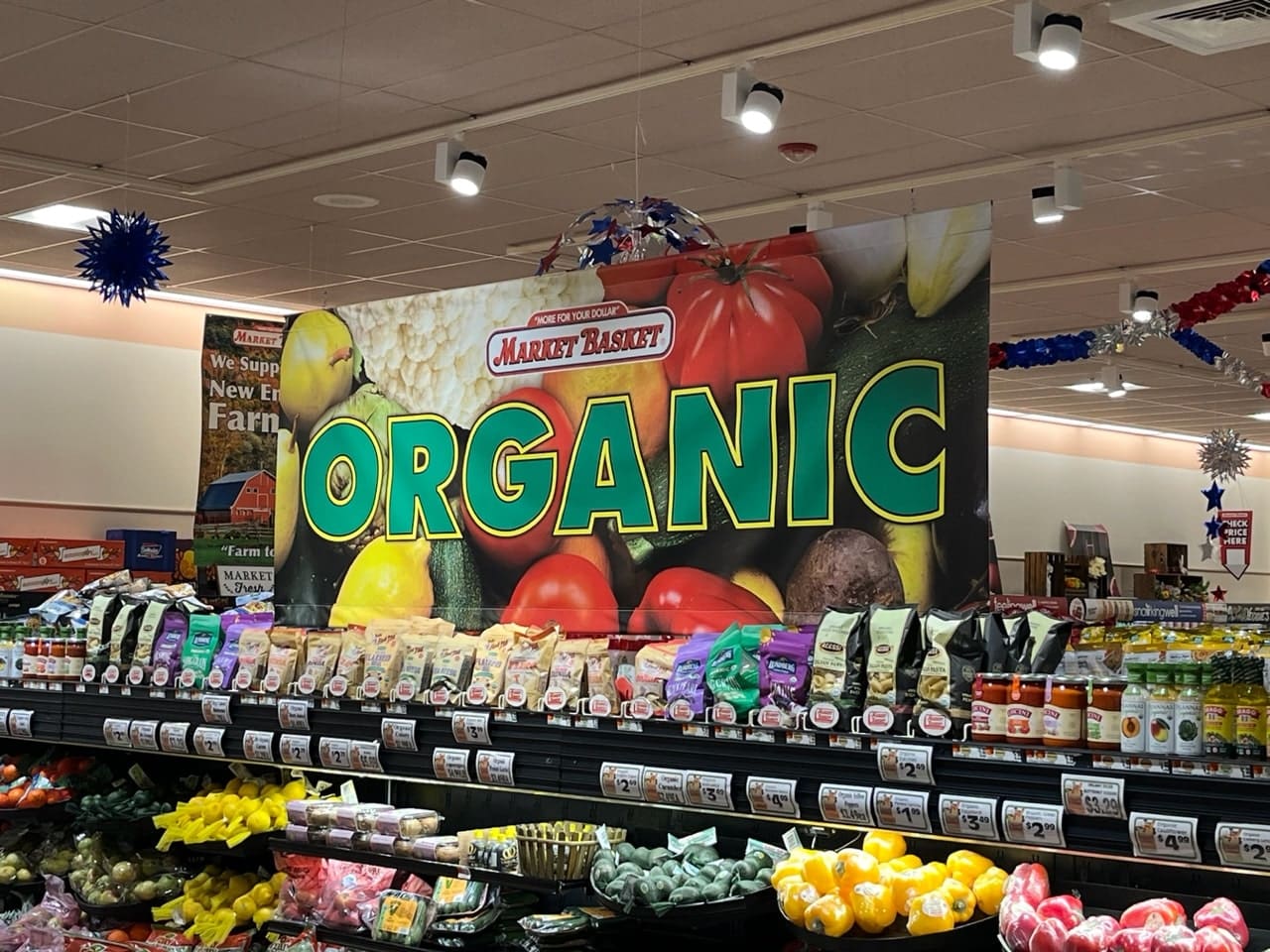
Case cards, department identification, organic and local call-outs. Ask for a water-tolerant face film and a laminate. Rigid is safer than adhesive on a misted surface.
Coolers and freezers
Door clings, glass decals, header strips. Ask specifically for a cold-apply adhesive rating and an installation temperature. This is where most grocery graphics fail.
Service counters
Menu and price panels, case toppers, allergen and sourcing notices. Ask for a wipeable surface: laminate on digital work, or a UV clear coat on screen work.
Center store
Aisle markers, shelf and endcap graphics, header cards, hanging signs. The cost question here is quantity and finishing, not durability.
Front end and windows
Checkout panels, entry door graphics, window posters. Ask about sun exposure and whether the glass needs to stay partly see-through.
Formats and finishing capabilities per Albert Basse Associates’ published service pages. Material ratings come from the media manufacturer and should be requested in writing.
Three of these overlap with work that has its own guide. Floor decals in the produce and promotional aisles are covered in our guide to floor graphics. Entry and window work is covered in our storefront window graphics guide. Clings and adhesive decals, and the difference between them, are covered in our custom decals guide.
Cold cases and wet cases cause most of the failures
Two physical problems account for most of the grocery graphics that come down early.
Cold surfaces. A pressure-sensitive adhesive needs to flow slightly into the surface it is pressed against. On cold glass or cold metal it stays stiff and never keys in. The sign looks fine on installation day and lifts at the corners a week later. The fix is a media with a cold-apply or low-temperature adhesive rating, and an installation crew that knows the minimum application temperature. Both are material and process questions, so settle them before the file goes to press.
Condensation. A freezer door sweats. A misted produce case sweats. Adhesive applied over that film of water is adhering to water, not to glass. Where a department is reliably damp, a rigid printed panel held in a fixture or channel is a more durable answer than anything adhesive, which is why so much produce signage is a board in a holder rather than a decal on the case.
Cleaning is the condition nobody specifies
Every sign within reach of food gets cleaned, and it gets cleaned with something stronger than water. Sanitizer and degreaser will lift unprotected digital ink off a face film, usually starting at the edges and at the darkest areas of coverage.
There are two protections, and which one you get depends on the press the job runs on.
On digital work, the protection is a laminate applied over the print. We laminate and mount up to 60 inches wide. Our published outdoor durability for digital print is two to three years, and five years when it is laminated, which is a reasonable guide to how much a laminate is doing in a wiped indoor environment as well.
On screen-printed work, the protection can be built into the ink film. Our screen presses run UV inks including 100 percent clear coats and varnishes, so the protective layer is printed rather than applied afterward. For a long run of identical signs that will be handled and wiped, that is often both the tougher and the cheaper answer.
What we print grocery signage on in Stoughton
Albert Basse Associates has been printing since 1928, and the whole job sits in one 35,000-square-foot plant at 175 Campanelli Parkway in Stoughton. Prepress, digital printing, screen printing, and finishing and fulfillment are all in the same building, which matters for a grocery program because a single promotion usually touches all four.
On the digital side, we run a Durst P5 350/HS, a SwissQprint Nyala 4, a 64-inch Seiko ecosolvent roll-to-roll printer, and a Xerox C70 for shorter sheet work. Digital output goes to 720 DPI, handles rigid material up to two inches thick, and white and clear inks are available for work that has to read on glass or against a colored substrate.
On the screen side, we run five presses, UV and combination UV and conventional flatbeds. Every screen press lays down spot PMS color, fine line halftones and four-color process. Flat, exact brand color across thousands of identical pieces is what this line is for.
Choosing between them is a quantity and color question rather than a quality one, and we have written it up in detail in our comparison of screen and digital printing. For rigid center-store signage specifically, corrugated plastic is the most common substrate, and our guide to coroplast and rigid printing covers how it is printed and how long it lasts.
Finishing and fulfillment is where a grocery order usually gets complicated, and it is all in house: custom die cutting to 37 by 55 inches with larger sizes as a job needs them, guillotine cutting, laminating and mounting to 60 inches, grommeting, stitching and heat seal, display hardware and fixtures held in stock, custom display assembly, collating and packaging, and nationwide drop shipping.
Reorders are the real test of a grocery signage program
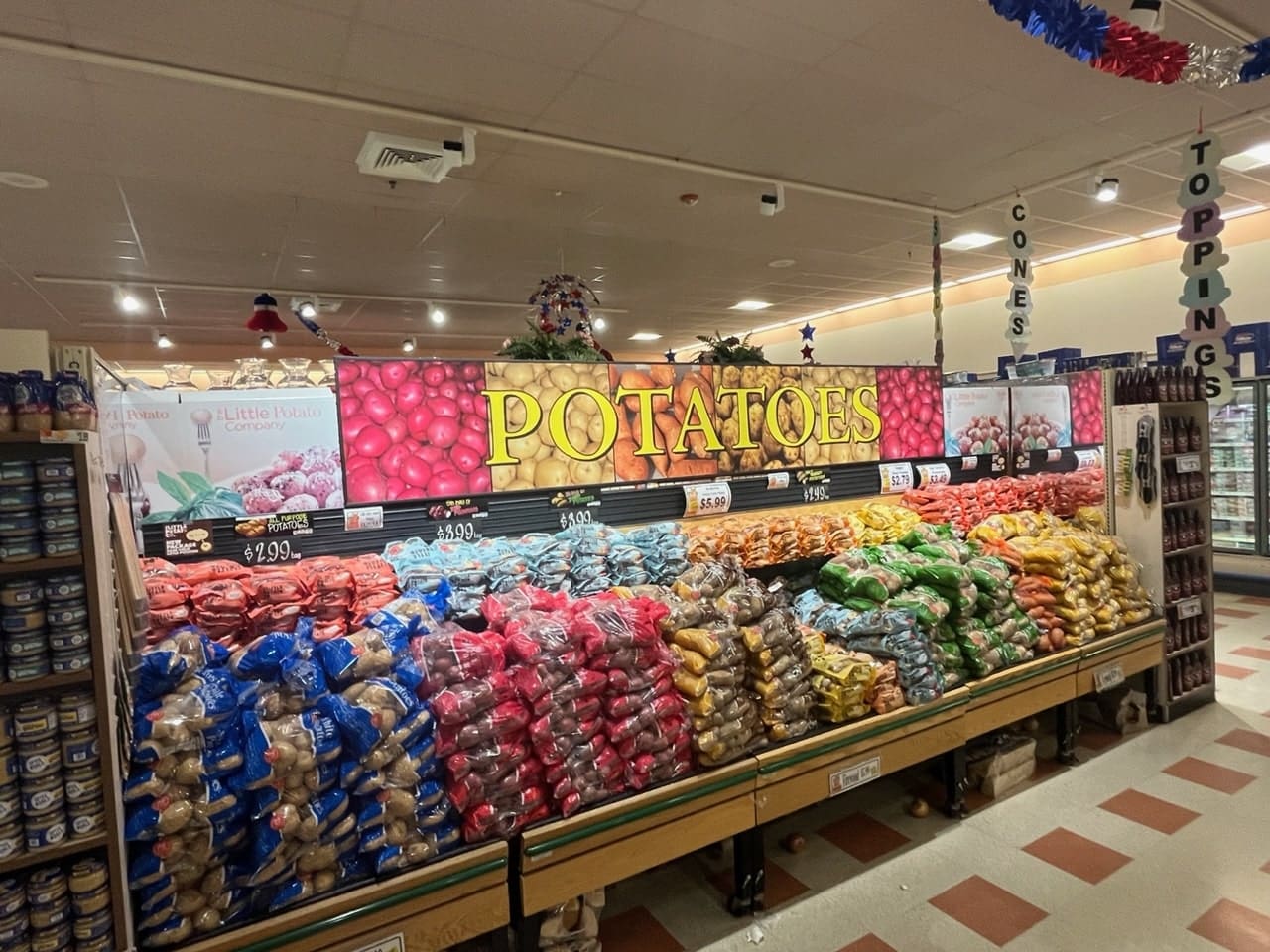
Grocery signage repeats. The same produce department identification goes back up every year. The same seasonal promotion runs every spring. The same price card format gets reprinted whenever the range changes. A supplier that prints a beautiful first run and cannot match it in eighteen months has not solved the problem.
Three things make a reorder match the original.
A contract proof on the first run. Our prepress and design department proofs on an Epson Stylus Pro 9900. Approving color against a contract proof once gives every later run a fixed reference, rather than a memory of what the last batch looked like.
Spot color where the brand depends on it. If a department color or a private label color has to be exact across every store, specify it as a spot PMS color and expect the long runs to go to the screen line, where flat spot color is native.
Held files and held tooling. Repeat formats are worth setting up once properly: a die for a recurring shape, a template for a recurring price card. The setup is a first-order cost and a saving on every run after it.
For retailers running the same program across many locations, the logistics matter as much as the print. We collate, package and drop ship nationwide through UPS and FedEx, so each store can receive its own carton rather than a pallet going to one address to be redistributed. Our national rollouts page covers how a multi-location program is sequenced.
What to send, and what to ask for back
A grocery quote comes back faster and more accurately with these in hand.
- A department list with quantities per store, and a store count. This is the single biggest driver of which press the job runs on.
- Finished size for each item, and whether it sits in an existing fixture. If it does, send the fixture dimensions or a photograph of it.
- Where each item installs. Name the surface: cooler glass, painted metal, laminate shelf edge, free-standing in a holder.
- Brand colors as PMS references rather than as a screenshot.
- Vector artwork with fonts outlined, and photographs at full size rather than scaled up.
- Whether this run repeats. Say so at quote stage; it changes whether tooling is worth cutting.
Ask for the media’s adhesive rating and expected life in writing, a contract proof before the full run, and confirmation of how the order ships and in what cartons.
Signage in other store formats works differently. Convenience stores are covered in our convenience store signage guide, quick-service restaurants in our QSR signage guide, and directional signage in our guide to retail wayfinding. The full range is on our products page.
Frequently asked questions
What material should a freezer door graphic be printed on?
On a film whose manufacturer states a cold-apply or low-temperature adhesive rating, and laminated if it will be handled. Ask for that rating in writing before artwork is approved. The print itself is rarely the limiting factor on a freezer door; the adhesive is.
Can printed signage go in a wet produce case?
Yes, but a rigid printed panel in a holder or channel is usually more durable there than an adhesive graphic, because misting and condensation work against any adhesive. Specify a laminated face and a substrate that does not swell.
Should grocery signage be printed digitally or screen printed?
Short runs, store-specific content and photographic images go digital. Long runs of identical signs in flat brand color go to the screen line, which also lets the protective clear coat be printed rather than laminated. The crossover depends on quantity, color count and size, so ask for both prices on a job near the line.
How long will grocery signage last?
Our published outdoor durability for digital print is two to three years, and five years laminated. Indoors, life is usually decided by cleaning and handling rather than by light, which is why a laminate or printed clear coat matters more in a supermarket than people expect.
Can you ship directly to each of our stores?
Yes. We collate, package and drop ship nationwide through carriers including UPS and FedEx, so each location receives its own carton.
Do you work with retailers outside Massachusetts?
We work primarily with clients across New England and serve customers throughout the northeast, printing and shipping from Stoughton.
Get grocery signage specified for your stores
Send a department list, a store count and the surfaces each sign installs on, and we will come back with a specification and a price per item rather than a single number for the store. If a run repeats every season, say so, because that changes how it should be built.
Call (781) 344-3555 or use our contact form, and we will respond within 24 hours to discuss your project needs.