Clothing Store Signage in Boston: Fixtures, Campaign Sets and Changeover Day

The room is the easy part. A clothing store is dry, heated and lit, and it is the same temperature in March as it is in August. Nothing in it is misted, frozen or wiped down with degreaser. The material question that decides a grocery or restaurant job barely comes up.
What makes apparel signage hard is everything around the material. The graphics hang on fixtures built to a manufacturer’s dimensions, not to yours. The set turns over several times a year while the fixtures stay put. And every store is supposed to change on the same morning, which means the print job is also a packing job.
Key Takeaways
- Measure the fixture, not the wall. Almost every piece in an apparel set drops into something that already exists: a header channel, a sign holder, a frame, a table card stand. Send the fixture’s dimensions and a photograph, and the size question is settled before artwork starts.
- The surface decides the adhesive, and the lease decides the surface. Glass, painted drywall and a laminate fixture panel are three different mounting decisions. In a leased storefront, removability is part of the specification, not an afterthought at takedown.
- One brand color, several substrates. The same red behaves differently on a coated card, a vinyl wall graphic and a fabric panel. Approve it once on a contract proof and every later piece has a fixed reference.
- Quantity decides the press. Store-specific and photographic work runs digitally. The same panel repeated across every store in flat brand color usually belongs on the screen line.
- Changeover day is a packing problem. One labeled carton per store, packed in install order, is what makes a same-day change possible across a chain.
What a clothing store signage set actually contains
An apparel campaign is rarely one sign. It is a set of small pieces repeated across stores, plus one or two large pieces that carry the season.
- Window graphics. The largest surface in the campaign and the one the street sees. Material, adhesive and glass conditions are covered in our guide to window graphics in Boston.
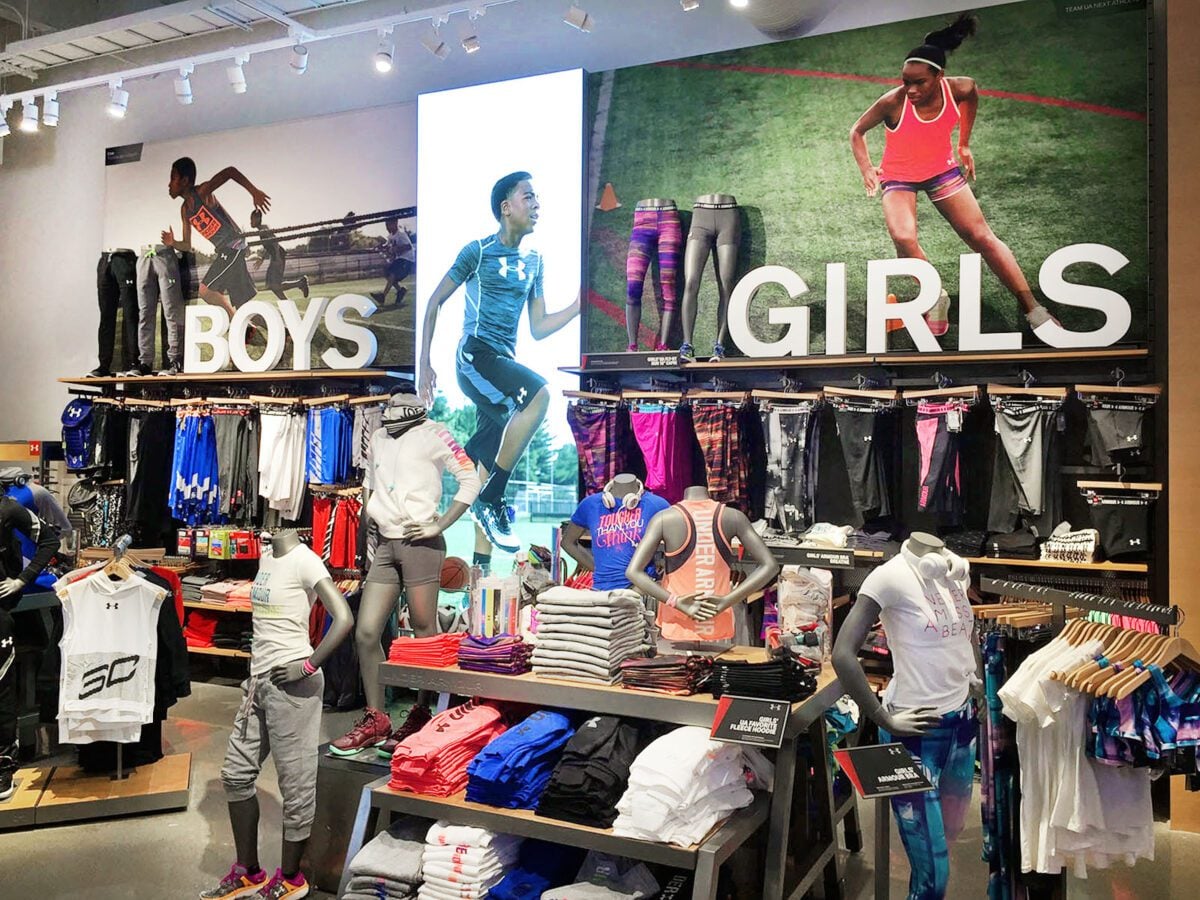
- Department and zone identification. The graphics above a fixture run that tell a shopper where men’s, women’s, kids’ or footwear starts.
- Fixture graphics. Header panels, side panels and insert cards cut to the fixture’s opening.
- Table and shelf-edge cards. Small-format, high quantity, and the pieces most likely to be reprinted mid-season.
- Standees and cutouts. Rigid, die cut to shape, usually one or two per store.
- Hanging and fabric graphics. Tension fabric and hanging structures are covered on our fabric and SEG displays page.
- Floor graphics. Specified by the floor surface and by slip resistance, which we cover in our guide to floor graphics.
- Fitting room and back-of-store messaging. Small, permanent, and usually ordered once rather than per campaign.
Splitting the set this way at quote stage matters, because the small repeated pieces and the large singular pieces run on different presses and finish differently. A single price for “the campaign” hides that.

Size the graphic to the fixture, not to the wall
Retail fixtures arrive from a fixture manufacturer with fixed dimensions, and store teams install graphics into them in a few minutes without tools. That means the print has to fit the opening exactly. A header panel an eighth of an inch too wide does not go in, and one that is too narrow shows a gap on both sides.
Two measurements settle it. The sight size is the opening a shopper can see. The overall size is the full panel including whatever is hidden by the channel or frame. Artwork is built to the overall size, important copy is kept inside the sight size, and the difference between them is where tolerance lives. If you do not know both, send a photograph of the fixture with a tape measure in it and we will work them out.
On what we can produce at our Stoughton plant: our digital presses include a Durst P5 350/HS that prints both roll and board material up to 3.5 meters wide, a SwissQprint Nyala 4, a 64-inch Seiko ecosolvent roll-to-roll printer and a Xerox C70 for shorter sheet work. Rigid material up to two inches thick runs on the flatbeds, output goes to 720 DPI, and white and clear inks are available for work that has to read on glass or against a colored substrate.
Finishing is where the fixture sizes get met: a 60 by 120 inch Zünd cutting table for contour and router work, custom die cutting to 37 by 55 inches with larger sizes as a job needs them, guillotine cutting, and laminating and mounting up to 60 inches wide. If a piece is larger than what runs in one piece, raise it at quote stage rather than after artwork is approved.
Mounting in a leased space
Most apparel stores are leased, and most leases make you responsible for the wall you hand back. Specify removal at the same time you specify the graphic.
Glass takes either an adhesive film or a static cling, and the choice is a question of how long the campaign runs and who takes it down. Our decal buyer’s guide covers adhesive grades, laminates and removal in detail.
Painted drywall is the surface that generates repair bills. Ask for a removable-grade adhesive rated for the paint it is going on, and get that rating in writing from the media supplier before artwork is approved. No printer can add removability to a film afterward.
Fixture panels and channels are the easiest case, because nothing adheres to anything. A rigid printed panel drops in and comes out. Where a campaign repeats, this is the mounting method worth designing toward: we hold a wide assortment of display hardware and fixtures in stock and build custom display assemblies, so a recurring piece can be given a permanent home rather than a new adhesive every quarter.
Holding one brand color across several substrates
An apparel set asks the same color to appear on a coated card, a vinyl window film, a rigid panel and sometimes a fabric panel. Those four surfaces absorb and reflect ink differently, and nobody notices until the pieces are in one room.
Three things keep them together.
A contract proof. Our prepress and design department proofs on an Epson Stylus Pro 9900. Approving color against a proof once gives the second and third runs a fixed reference instead of a memory.
Spot color where the brand depends on it. Every one of our screen presses lays down spot PMS colors, fine line halftones and four-color process. For flat, exact brand color across thousands of identical pieces, that is what the screen line is for. The same line runs UV inks including 100 percent clear coats and varnishes, and solvent inks in metallic, neon and other special effects when a campaign calls for them.
The right press for each piece. Choosing between screen and digital is a quantity and color question rather than a quality one, and we have written it up in our comparison of screen and digital printing. In practice one campaign often uses both: photographic lifestyle panels digitally, flat repeated cards on screen.
Changeover day is a packing problem
A campaign that arrives as a pallet of mixed pieces gets installed over a week. A campaign that arrives as one labeled carton per store gets installed in a morning.
We collate, package and drop ship nationwide through carriers including UPS and FedEx, so each location receives its own carton rather than one address receiving everything to redistribute. Pack order is worth specifying: windows first, then department identification, then fixture and table cards, with an install sheet on top. For retailers running the same change across many locations, our national rollouts page covers how a multi-location program is sequenced.
Build the reprint into the plan as well. Table and shelf-edge cards get handled, bent and lost. Ordering a modest overage per store with the original run costs far less than a second setup six weeks later.
What to send with an apparel campaign quote
A quote comes back faster and closer to the real number with these in hand.
- A store list with a count, and quantities per store for each item. This is the single biggest driver of which press the job runs on.
- Fixture dimensions, sight size and overall size, or photographs of the fixtures with a measurement in frame.
- The surface each piece mounts to. Name it: glass, painted drywall, laminate fixture panel, free-standing holder.
- Brand colors as PMS references, not as a screenshot.
- Vector artwork with fonts outlined, and photography at full size rather than scaled up.
- The changeover date, and whether the campaign repeats. A repeating format can justify tooling that a one-off cannot.
Ask for a contract proof before the full run, the adhesive grade and removability rating in writing for anything that sticks to glass or a wall, and confirmation of how the order is packed and labeled per store.
Other store formats work differently. Supermarkets are covered in our grocery signage guide, convenience stores in our convenience store guide, quick-service restaurants in our QSR signage guide, and directional signage in our guide to retail wayfinding. The full range is on our products page.
Frequently asked questions
What sizes do you need before you can quote fixture graphics?
The sight size and the overall size of each fixture opening, plus the quantity per store. If those are not documented, a photograph of the fixture with a tape measure in frame is usually enough to work from.
Can window graphics be removed at the end of a campaign without damaging the glass or the paint?
On glass, yes, with the right adhesive grade or a static cling. On painted drywall it depends entirely on the film, which is why the removability rating has to come from the media supplier in writing before artwork is approved. Our decal guide goes through the grades.
Should apparel campaign graphics be printed digitally or screen printed?
Short runs, store-specific content and photographic images go digital. Long runs of identical pieces in flat brand color go to the screen line, where spot PMS color is native and a clear coat can be printed rather than laminated. On a job near the line, ask for both prices.
Can you ship a separate kit to each of our stores?
Yes. We collate, package and drop ship nationwide through carriers including UPS and FedEx, so each location receives its own carton. Tell us the pack order you want and we will label to it.
How long will interior apparel graphics last?
Indoors, campaign graphics are usually replaced long before the print wears out. Our published outdoor durability for digital print is two to three years, and five years when laminated, which is a reasonable guide for anything in a window taking direct sun.
Do you work with retailers outside Massachusetts?
We work primarily with clients across New England and serve customers throughout the northeast, printing and shipping from Stoughton.
Get a campaign set specified for your stores
Send a store count, the fixture sizes and the surfaces each piece mounts to, and we will come back with a specification and a price per item rather than one number for the campaign. Tell us the changeover date at the same time, because it decides as much about how the job is built as the artwork does.
Call (781) 344-3555 or use our contact form, and we will respond within 24 hours to discuss your project needs.