Wall Coverings in Boston: A Commercial Printer’s Guide

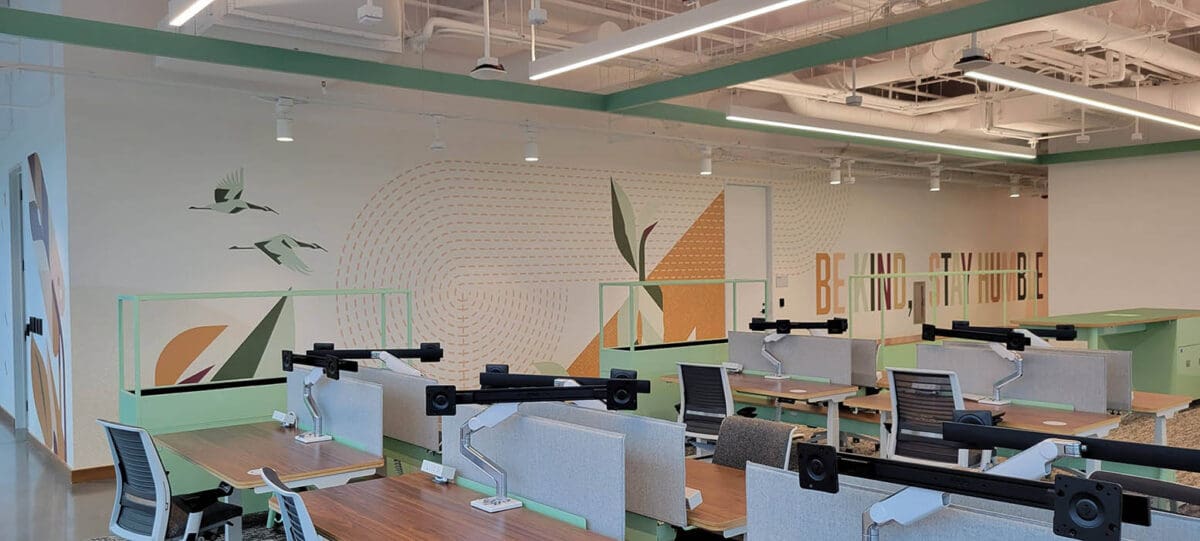
Wall coverings are large-format printed graphics, including custom murals, printed wallpaper, vinyl wraps, window films, and cut decals, applied directly to interior walls and other flat surfaces to brand a space, guide people through it, or refresh its look without construction. For a Boston hotel lobby, a Seaport retail buildout, or a medical office off Route 128, they turn a blank wall into a branded environment in days, not the weeks a renovation takes.
Demand is not a fad. The global wall covering market was valued at USD 41.40 billion in 2025 and is forecast to reach USD 53.63 billion by 2031, a 4.41 percent compound annual growth rate, according to Mordor Intelligence. Commercial interiors drive a large share of that spend, because a printed wall does marketing work a painted one cannot.
This guide comes from Albert Basse Associates, a family-owned Stoughton printer that has produced graphics for New England businesses since 1928. It covers what wall coverings are, where they earn their cost, which materials hold up in a commercial space, how digital and screen printing differ, and how to choose an installer near you.
Key Takeaways
- Wall coverings are custom-printed murals, wallpaper, wraps, window graphics, and decals applied to interior surfaces to brand or transform a space.
- They are a renovation alternative. You get the visual impact of a remodel without the demolition, downtime, or construction cost.
- People spend about 90 percent of their time indoors (EPA), so the interior environment is where most brand impressions and staff wellbeing are formed.
- Material choice drives the result. Printable vinyl, PVC-free films, and breathable substrates each suit a different wall, traffic level, and lifespan.
- A partner that designs, prints, finishes, and installs under one roof removes the handoffs that stall an install.
What are wall coverings?
Wall coverings are digitally printed graphics engineered to adhere to walls, glass, and other flat surfaces, then removed or replaced when the message changes. One artwork, one wall, one branded result. They are printed to fit the exact space rather than bought in fixed rolls, which is what separates a commercial wall covering from consumer wallpaper off a shelf.
The category runs wider than the word “wallpaper” suggests:
- Printed murals and wallpaper cover a full wall with a photographic image, pattern, or brand scene.
- Wall wraps apply adhesive vinyl over columns, doors, elevator banks, and curved surfaces.
- Window and glass graphics add frosted films, privacy bands, and promotional messaging to storefronts and conference rooms.
- Decals and cut lettering place logos, wayfinding, and values statements without covering the whole wall.
- Fabric displays use tensioned graphics for large, wrinkle-free feature walls.
Behind all of them is wide-format digital printing. The wide-format printers market reached USD 13.75 billion in 2025 and is growing at 7.9 percent a year, per The Business Research Company, as inkjet resolution and media choices expand what a printed wall can look like. As a member of the DreamScape Print Provider Network, we print on premium media offering more than 20 textures and effects, from smooth matte to canvas, linen, and stone.
Why do Boston businesses invest in custom wall coverings?
Because the wall is where attention and mood are shaped, and printing it costs far less than rebuilding it. People in the United States spend roughly 90 percent of their time indoors, according to the U.S. Environmental Protection Agency. Whatever your customers, patients, or staff come to feel about a space, they mostly feel it inside one. A branded wall is a full-height, always-on version of your identity in that room.
The effect is measurable. Workplaces that bring natural imagery and design indoors report employees who are 6 percent more productive, 15 percent more creative, and 15 percent higher in wellbeing, per research summarized by the University of Minnesota Landscape Arboretum. A mural of a New England shoreline in an office, or a calming graphic in a clinic corridor, is a low-cost way to reach for those gains.
The interior effect
Why the room itself does the work
Time spent indoors, and what nature-led interiors measurably change.
U.S. EPA on time spent indoors; workplace research summarized by the University of Minnesota Landscape Arboretum.
Then there is the budget. A wall covering delivers the appearance of a major renovation without the demolition, dust, or downtime. Hotels, clinics, and offices use them to refresh a lobby or reception on a marketing budget instead of a construction budget, and to change the look again next quarter when a message or a season changes.
Which industries use wall coverings most?
Hospitality, healthcare, corporate offices, retail, education, museums, and multifamily properties lead, because each one owns a lot of wall and wants it working. Retail makes the case plainly. Even in 2026, e-commerce was just 16.9 percent of U.S. retail sales in the first quarter, the Census Bureau reports, so more than 80 cents of every retail dollar is still spent inside a physical store where the walls shape the visit.
- Hospitality: themed feature walls, restaurant graphics, and seasonal promotions in hotels and cafes.
- Healthcare: calming environments, wayfinding, and department branding in hospitals and dental and doctor offices.
- Corporate and office: mission walls, values graphics, and branded reception areas that set a tone for staff and visitors.
- Retail: store branding, product storytelling, and dressing-room and window graphics that pair with in-store retail display graphics.
- Education: school pride, motivational quotes, and donor recognition across colleges and universities.
- Museums and cultural spaces: exhibition graphics and informational walls that swap out as exhibits change.
- Multifamily and residential: amenity spaces, leasing offices, and staging for property staging and common areas.
Because the graphics are printed to your files, the same shop can serve every one of these spaces with one workflow.
What materials and finishes last in a commercial space?
The right material depends on the surface, the traffic it faces, and how long it needs to stay up. Because indoor air can carry pollutant concentrations 2 to 5 times higher than outdoor air, per the EPA, material chemistry matters in a room people occupy all day. We print on PVC-free media with post-consumer recycled content and lightweight, breathable substrates, produced through sustainable printing processes, so a lobby or a patient room is not trading a fresh look for off-gassing.
Beyond the base media, three choices shape durability:
- Temporary or permanent. Removable films lift cleanly for leased spaces and short campaigns. Permanent installs suit walls you own and messages that stay.
- Protective laminate. A laminate layer guards high-touch corridors, elevators, and lobbies against scuffs, cleaning chemicals, and fingerprints.
- Surface and texture. Smooth media reads best for photography, while canvas, linen, or stone textures suit feature walls and hospitality interiors.
Match the media to the job and a wall covering holds its color and edges for years indoors. Mismatch it, and a bargain film peels at the corners within a season.
Digital vs. screen printing for wall graphics
Digital printing wins for photographic murals, short runs, and fast turnaround, while screen printing wins for high volumes of bold, flat color at a lower unit cost. Most commercial wall coverings are digital, because they are one-off, image-rich, and needed quickly.
Our Durst P5 350 HS runs roll and rigid media up to 3.5 meters wide, at up to 708 square meters (7,620 square feet) per hour and photographic resolution up to 720 dpi, which is what makes a sharp floor-to-ceiling mural possible. For high-run projects with flat spot colors, our screen printing line holds consistent color across long runs.
| Factor | Digital printing | Screen printing |
|---|---|---|
| Best for | Photographic murals, short runs | Large volumes, flat solid color |
| Turnaround | Fast, direct from your files | Longer setup, then high speed |
| Color detail | Full photographic range, up to 720 dpi | Bold, consistent spot colors |
| Typical wall use | Custom murals, wraps, decals | High-count repeated graphics |
How to choose a wall covering partner in Boston
Choose a shop that designs, prints, finishes, and installs in-house, proofs the artwork before production, measures the actual wall, and is close enough to install the work and stand behind it. Every handoff between a designer, a printer, and an installer is a place a project loses time or accuracy, so one roof is an advantage, not a convenience.
Albert Basse Associates has done exactly that from Stoughton since 1928, and is one of the longest continually operating, family-owned, large-format and screen printers in the nation. As an authorized member of the DreamScape Print Provider Network, we produce wall coverings on premium media, then finish and install them across Greater Boston and New England.
To scope a wall covering project, request a quote with your wall dimensions and a photo of the space, or call us at (781) 344-3555. Our team will recommend the media, finish, and print method for the room and the message.
Frequently Asked Questions
How much do wall coverings cost?
Cost depends on square footage, the media and finish you choose, and whether you need installation. Because a printed wall replaces the demolition and rebuild of a renovation, it usually lands on a marketing budget rather than a construction one. Send your wall dimensions for a firm quote.
Do wall coverings damage the wall or come off cleanly?
That is a material choice. Removable films are designed to lift cleanly, which suits leased spaces and short campaigns, while permanent installs are meant to stay. Tell us whether you own or lease the space and we will spec accordingly.
How long do printed wall coverings last?
Indoors, a properly matched and installed wall covering holds its color and edges for years. A protective laminate extends life in high-touch areas such as corridors, elevators, and lobbies.
Can you match our exact brand colors and photographs?
Yes. Our prepress and color management, paired with photographic resolution up to 720 dpi, reproduce brand colors and high-resolution images accurately. Supply your logo files and photography and we proof before we print.
Do you install wall coverings in the Boston area?
Yes. We are based in Stoughton, MA, and design, print, finish, and install wall coverings across Greater Boston and throughout New England.
Written by the team at Albert Basse Associates, a family-owned large-format and screen printer at 175 Campanelli Parkway, Stoughton, MA, serving Greater Boston and New England since 1928. Reach us at (781) 344-3555 or info@albertbasse.com.