
Gym and Fitness Studio Graphics in Boston: Walls, Glass and Floors

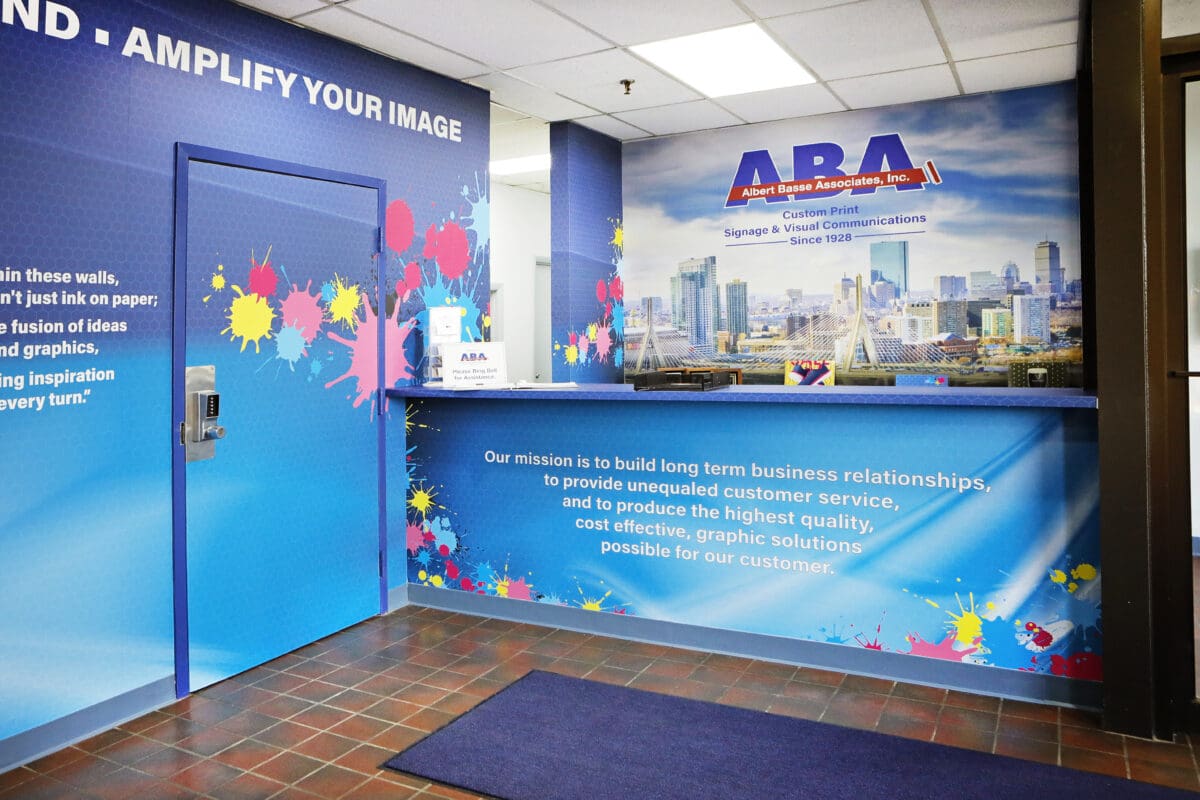
A fitness floor is one of the harder interiors to print for, and the design is not the reason. The reason is what happens to the surfaces. Mats get mopped. Studio glass gets wiped between classes. Equipment frames are touched a few hundred times a day. Rubber flooring is washed, and the wash reaches the edge of anything stuck to it.
Everything else about the job is ordinary interior print work: a logo wall in the studio, a window that tells the street what the schedule is, directions to the locker rooms. What makes a gym or studio different is choosing the material and the mounting for a room that gets cleaned harder than a store does, and leaving the working parts of the glass alone.
Key Takeaways
- Specify by zone, not by the building. Entry glass, studio walls, the training floor, the corridor and the locker entrances are five different material decisions. A single quote line for “gym graphics” hides all of them.
- The cleaning routine picks the film. Tell us what each surface is washed with and how often. The cleanability rating then has to come from the media supplier in writing, before artwork is approved.
- Leave the working glass clear. Door hardware, exit routes and an instructor’s sightline into a studio are not available for artwork, whatever the layout drawing suggests.
- Put floor graphics where feet walk, not where weights land. Traffic paths and studio entrances hold a graphic. A platform or a drop zone does not.
- One brand color, several substrates. The same red behaves differently on printed wallcovering, on window vinyl and on a counter card. Approve it once on a contract proof and every later piece has a fixed reference.
What a fitness facility graphics package usually contains
Almost no gym job is one sign. It is a set of pieces in different places, and each place sets its own material. Sorting the building into zones before anyone opens a design file is what keeps the quote honest.
- Storefront and entry glass. Name, hours, the class schedule, a membership offer, and door vinyl that works from the sidewalk. Material, adhesive grade and see-through options are covered in our Boston window graphics guide.
- Studio and training-floor walls. Large printed areas: a mural behind a rig, a motivational wall in a cycle studio, a brand wall members photograph. These are a printed wallcovering decision rather than a sign decision, and our wall mural guide goes through the artwork side.
- Block, column and partition surfaces. Logos, numbers, zone labels and rules on surfaces too rough or too small for a full covering. Usually cut or printed decals.
- The floor. Lane markers, studio entrances, distancing or queue marks at the desk. Substrate and slip rating decide this one, and both are covered in our floor graphics guide.
- Corridors, stairs and locker entrances. The part members ask the desk about on a first visit. This is wayfinding, and it is worth designing as a sequence rather than as individual signs.
- The front desk and retail shelf. Counter cards, shelf graphics and standees for supplements, apparel and personal training. Formats are on our products page.
- Anything that changes every few weeks. Class timetables, challenge boards, seasonal promotions. Printed fabric in a frame is built to be swapped, which is why SEG displays suit a schedule that moves and a painted mural does not.
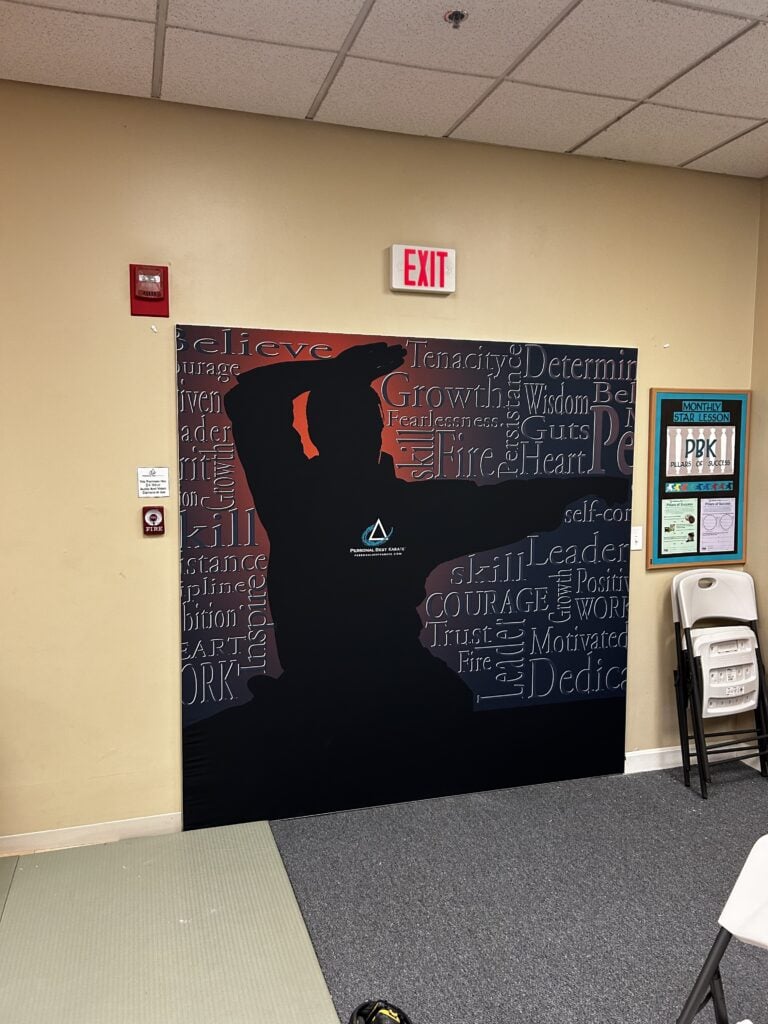
The cleaning routine decides the material
This is the question that gets skipped, and it is the one that decides whether a graphic looks right in eighteen months. A wall in a quiet office is dusted. A wall beside a squat rack is wiped with disinfectant, brushed by a shoulder, and occasionally hit by a dropped towel. A shower-area wall may be hosed.
So tell us three things about every surface: what it is, what cleans it, and how often. Painted drywall, cinder block, glass, rubber flooring, sealed concrete and a laminate desk panel are six different mounting problems, and the cleaner is as important as the surface. Then the specification follows: a film rated for repeated cleaning, and in most high-contact places an overlaminate over the print, which is what takes the scuffing and the wiping instead of the ink.
Two limits are worth knowing before you plan the pieces. We laminate and mount up to 60 inches wide in Stoughton, which sets the widest single mounted panel. Our wallcovering media is printed on the Durst P5 350/HS, a hybrid press that handles roll and board work up to 3.5 meters, so a studio wall is usually printed as drops rather than as one piece. Tell us the wall width and we will tell you where the seams fall.
For the wallcovering itself we are a member of the DreamScape Print Provider Network, authorized to print on their media, and the wall coverings and decals we produce use PVC-free materials, post-consumer recycled content and lightweight breathable substrates. Whatever the media, the washability claim comes from that media’s own data sheet, not from us.
Glass: what to brand, and what to leave clear
A fitness business has more glass than most retailers, and it does two jobs at once. The street-facing glass sells the place. The internal glass lets an instructor see a class and lets a member see whether a studio is busy.
That makes three areas off limits before design starts. Door hardware and the push and pull zones have to stay usable. Exit routes and any glass your fire plan relies on stay clear. And the sightline into a studio stays open at the height people actually look through, which is lower than most layout drawings assume.
Between those, the options are the normal storefront set: solid printed vinyl where you want a wall, perforated or see-through film where you want graphics and visibility, and frosted-effect film where you want privacy at eye level and daylight above it. Which of those suits each pane, how much of a window you are allowed to cover, and how long each film lasts in direct sun are all in the window graphics guide.
Floor graphics belong where feet walk
Floor graphics do real work in a gym. They mark a studio entrance that is easy to miss, hold a queue line at the desk, number a lane, or point at the locker rooms from the middle of the floor where there is no wall to use.
They also fail in predictable places. A graphic in a drop zone, under a platform, or where a bench gets dragged across it will not last a season, and no laminate changes that. Rubber flooring is a harder adhesive problem than sealed concrete or tile, because the surface is slightly textured and often slightly oily from manufacture. The honest answer is to place graphics on walking surfaces and keep them out of lifting areas.
Slip resistance matters too, because these are surfaces people cross in sneakers and sometimes barefoot. Our floor graphics guide covers the material options, the slip ratings and how long each one lasts, so it is the right place to start before you mark up a floor plan.
Wayfinding a new member can use without asking
The first visit is the test. Someone arrives, checks in, needs a locker, needs the floor, then needs a specific studio at a specific time. If any of those four steps needs a staff member, the signage has not done its job.
Two habits fix most of it. Name studios instead of numbering them, because a member remembers “Ride” and not “Studio 2”. And put the schedule where people are already standing still, which is the check-in queue and the corridor outside the studio door, not only on the home page. Our guide to signage for better wayfinding goes through planning a sequence rather than a set of one-off signs, and the broader interior picture is in our environmental graphics guide.
Holding one brand color across a mural, a window and a counter card
A fitness brand’s color shows up on a printed wall, on window vinyl, on a floor graphic and on a card at the desk. Those are different media printed on different presses, and left alone they will not match.
Two things keep them together. First, a contract proof: we proof on an Epson Stylus Pro 9900 before production, which gives you a color-accurate reference to approve once instead of judging each piece on its own. Second, choosing the press for the job rather than for the quantity alone. Our screen presses produce spot PMS colors, fine line half tones and four-color process, so a flat brand color repeated across many identical pieces can be laid down as an actual mixed ink. Photographic murals, store-specific panels and short runs belong on the digital side. If a job sits near that line, our screen printing versus digital printing guide explains how the decision is made, and you can ask for both prices.
Either way, send vector logo files and your color references to prepress at the start. That is also where artwork gets checked and scaled before anything prints.
Multi-site studios and franchise changeovers
A single studio is a site visit. Ten studios on the same brand is a packing job as much as a print job, and the thing that breaks is not the printing — it is ten locations opening a shared box and nobody knowing which pieces are theirs.
We collate, package and drop ship nationwide through carriers including UPS and FedEx, so each location receives its own carton, and we keep a range of display hardware and fixtures in stock along with custom display assembly. Tell us the pack order you want and we label to it. For how a staged multi-location program is run, see our note on national rollouts.
What to send with a quote request
- A photo of every wall, window and floor area you want covered, with a tape measure in frame.
- What each surface actually is: painted drywall, block, glass, rubber, sealed concrete, laminate.
- What cleans each surface, and how often.
- Which pieces change seasonally and which are meant to stay for years.
- Vector logo files and your brand color references.
- Site count, and the date you want the graphics up.
Frequently asked questions
What material should go on a gym wall?
It depends on the surface and on the cleaning. Large smooth areas such as painted drywall usually take printed wallcovering. Block, columns and small areas usually take cut or printed vinyl decals. In either case the film’s cleanability rating is what settles it, so send a photo of the wall and tell us what it is washed with.
Will wall graphics survive being wiped down every day?
The right film and overlaminate will, and the wrong one will not. We ask the media supplier for the cleanability rating in writing before artwork is approved rather than guessing, and we laminate and mount up to 60 inches wide in Stoughton.
Can you print studio glass without blocking the view into the room?
Yes. Perforated and see-through films give you graphics on the glass while keeping sightlines, and frosted-effect film gives privacy at eye level with daylight above it. The options and their trade-offs are in our window graphics guide.
Can a floor graphic go on rubber gym flooring?
Sometimes, and it depends on the texture and the adhesive more than on the print. Walking surfaces and studio entrances are the places that hold. Lifting platforms and drop zones are not. Our floor graphics guide covers the material and slip-rating choices.
Do you install wall coverings, or do we arrange that?
We print and install custom wall coverings, handled by our own experienced professionals. For other formats, ask when you request the quote so installation is priced with the job rather than after it.
Do you work with gyms and studios outside Massachusetts?
We work primarily with clients across New England and serve customers throughout the northeast, printing and shipping from Stoughton.
Get a package specified for your facility
Send photos of the zones, what each surface is, and what cleans them. We will come back with a specification and a price per area rather than one number for the building, and we will tell you which pieces are worth building to change and which are worth building to last.
Call (781) 344-3555 or use our contact form, and we will respond within 24 hours to discuss your project needs. We print in Stoughton, MA, and have been a printer in the Boston area since 1928.