Retail Display Graphics: A Boston Printer’s Spec Guide

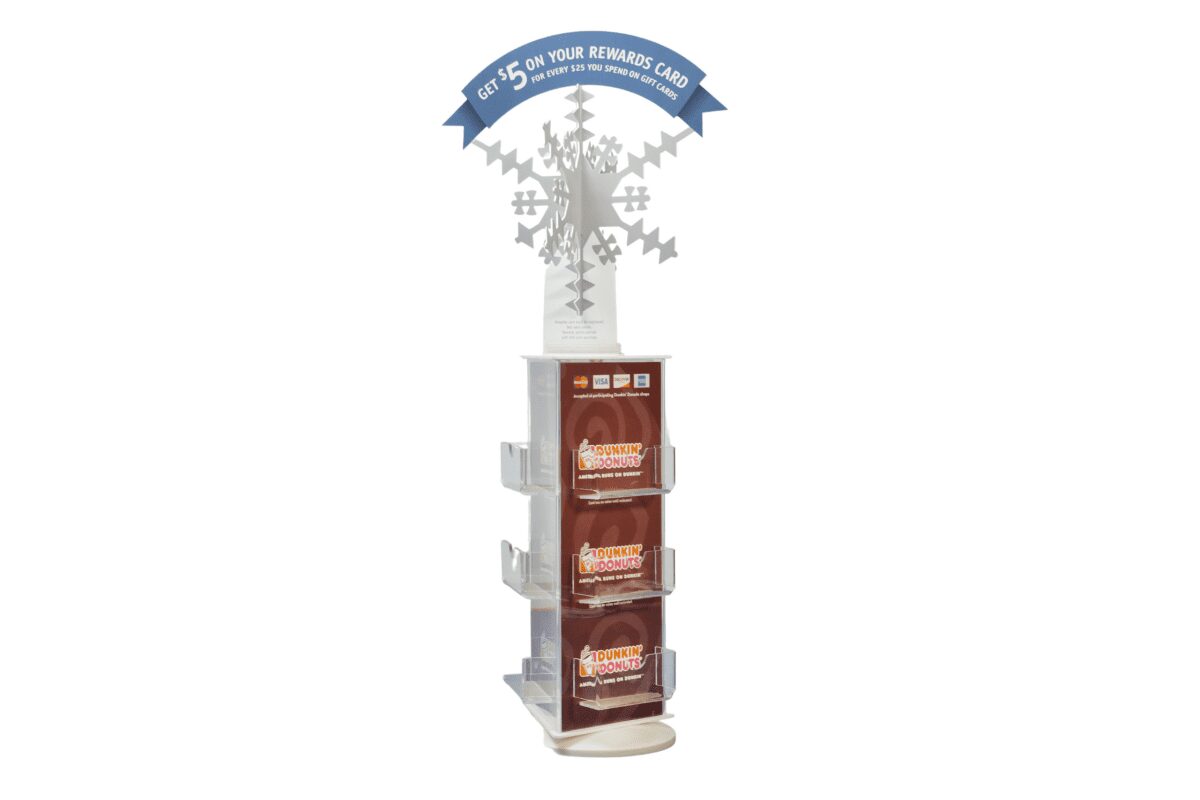
Retail display graphics are the printed point-of-purchase pieces that carry a campaign inside the store: header cards, endcap panels, window clings, floor graphics, shelf strips, standees, wall murals, and fabric-framed lightboxes. Specifying them well comes down to four decisions made in order: substrate, print method, finishing, and rollout logistics. Get those four right and a campaign lands in every store on the same day, in the same color, and still looks right in week twelve.
Most graphics programs do not fail at the design stage. They fail when a substrate curls in a humid vestibule, when store 47 gets a different red than store 3, or when the kitting plan was an afterthought and half the boxes arrive after the promotion started. This guide is written for the marketing manager, visual merchandiser, or agency producer who has to prevent that.
Key Takeaways
- E-commerce accounted for just 16.9% of US retail sales in Q1 2026, per the US Census Bureau. The overwhelming majority of buying still happens where a printed graphic can reach the shopper.
- Substrate first, print method second. The material has to survive the environment; the press only has to reproduce the art.
- Digital printing wins below roughly 500 pieces. Screen printing wins above it, and screen wins outright when you need specialty inks or exact PMS spot color across a long run.
- Laminate is the cheapest durability upgrade you can buy. Unlaminated digital output rates 2 to 3 years outdoors. Laminated output rates about 5 years.
- Kitting and fulfillment decide whether the rollout works, not printing. Plan store-level packouts before the first proof.
- Ask for ASTM E84 Class A ratings on any wall covering going into a commercial interior, and PVC-free media if the project is chasing LEED credits.
What are retail display graphics, and why do they still decide the sale?
Share of U.S. retail sales, Q1 2026
Source: U.S. Census Bureau, Q1 2026 — $326.7B e-commerce of $1,929.0B total.
Retail display graphics are printed visual assets placed inside a store to direct attention, explain an offer, and close the purchase at the shelf. They still decide the sale because the sale still happens in the store. The US Census Bureau put Q1 2026 e-commerce at $326.7 billion against $1,929.0 billion in total retail sales, which is 16.9%. Roughly 83 cents of every retail dollar moved outside e-commerce.
The in-store influence numbers point the same direction. Vestcom’s November 2025 consumer research, based on 2,000 US respondents, found that 72% of shoppers made an unplanned purchase because of in-store messaging, and that 81% notice and engage with brand messaging most along the entry-to-aisle-to-endcap path. Price and promotional messaging ranked as the most influential message type at 88%.
That is the practical argument for spending real money on the physical piece. A shopper who saw your ad on a phone is standing in front of your product with a decision to make. The graphic in front of them is the last thing that speaks. We covered the strategic case for print in more depth in Why Retail Display Graphics Still Rule in the Digital Age, and the design side in 5 Keys to High-Converting POP Displays.
Should you choose digital printing or screen printing?
Choose digital printing for short runs, variable content, and photographic imagery. Choose screen printing for long runs, exact spot color, and specialty ink effects. The break-even usually sits somewhere around 500 pieces, and it moves based on how many colors are in the art and how large each piece is.
Digital is a per-piece cost with almost no setup. Screen carries a setup cost per color, then the per-piece cost falls off a cliff. Our 5-color inline UV screen press produces prints up to 82 by 62 inches at speeds up to 500 sheets per hour, so once the screens are burned, volume is cheap. On the digital side, the Durst P5 350/HS prints up to 11.5 feet wide, handles media up to 2.8 inches thick, and reaches 708 square meters per hour (7,620 square feet per hour) with LED curing.
| Decision factor | Digital printing | Screen printing |
|---|---|---|
| Best run length | 1 to roughly 500 pieces | 500 pieces and up |
| Setup cost | Effectively none | Per color, per job |
| Photographic imagery | Excellent, up to 720 DPI | Possible, via halftones |
| Exact PMS spot color | Close match | Exact, mixed to spec |
| Specialty inks | White and clear ink | Metallic, neon, DayGlo, glow-in-the-dark, scratch-off, glitter, pearlescent |
| Variable data or store-specific art | Straightforward | Not practical |
| Typical use | Test runs, regional promos, murals | National rollouts, long-life signage |
There is a third answer that people forget: run both. A national program might screen print the 4,000 common endcap panels and digitally print the 60 store-specific variants. That is a normal week here. See our digital printing and screen printing capabilities for the full equipment list.
Which substrate should you spec for each display type?
Spec the substrate from the environment, not the design. A graphic in a refrigerated case, a graphic in a sunlit window, and a graphic on a concourse wall are three different material problems even if the artwork is identical.
Our finishing floor works with materials up to 2 inches thick, laminates and mounts up to 60 inches wide, and die cuts up to 37 by 55 inches with larger sizes handled as needed. That envelope covers nearly every retail display format. Here is how the common ones map:
| Display type | Typical substrate | Why it works |
|---|---|---|
| Endcap and header cards | Coated board, styrene | Prints sharp, die cuts cleanly, ships flat |
| Freestanding standees | Corrugated, foam board with easel | Light, rigid, low ship weight |
| Window and door graphics | Clear or perforated vinyl, static cling | Adheres without residue, removable per campaign |
| Floor graphics | Textured overlaminated vinyl | Slip resistance and abrasion resistance |
| Outdoor and entry signage | Coroplast, aluminum composite | Survives freeze, thaw, and salt |
| Wall murals and environmental graphics | PVC-free printable wall covering | Class A fire rating, breathable, removable |
| Backlit and framed displays | SEG fabric with silicone edge | Wrinkle free, swaps in minutes, no wall damage |
Two format notes worth calling out. Rigid substrate work is its own discipline, and we wrote a full breakdown in the Coroplast Signs and Custom Rigid Printing guide. And if your campaign changes more than twice a year, look hard at fabric and SEG displays: the aluminum frame stays on the wall permanently and you ship only a folded fabric graphic each cycle, which cuts freight and eliminates reinstallation labor. Browse the full product range if you are still scoping formats.
How long will retail display graphics last?
Plan on 2 to 3 years of outdoor life for unlaminated digital output, and about 5 years with a laminate. Indoor graphics out of direct sun last considerably longer. Those are our own field-tested numbers for the digital presses in our plant, and they are the single most useful spec to get on the table before anyone argues about price.
Laminate is the cheapest durability decision available. It adds a modest per-square-foot cost and roughly doubles outdoor service life, while also adding scuff resistance for anything at cart height. If a graphic is going somewhere a customer will touch it, laminate it.
For interior wall work, durability is a code question as much as a wear question. As a member of the DreamScape Print Provider Network, we print on Terralon, whose published technical specifications list a Class A ASTM E84 fire rating, a minimum 31% post-consumer recycled content, PVC and olefin free construction, and a 66 perm breathability rating against a WA 101 minimum of 8 perms for breathable wall covering. Breathability matters more than it sounds: material that lets water vapor pass through helps prevent mold behind the graphic. Full details are on our wall coverings page.
How do you plan a multi-store rollout without blowing the schedule?
Plan the packout before you approve the proof. In a multi-store rollout, printing is rarely the bottleneck. Sorting, kitting, labeling, and shipping to the right store on the right day is where programs slip.
The volume of this work is real. Target’s March 5, 2026 announcement committed to more than 30 new stores and more than 130 remodels in a single year, backed by a $5 billion capital investment plan. Every one of those locations needs a graphics package cut, kitted, and delivered on a construction schedule that does not wait.
Four things to lock down early:
- Store-level bill of materials. Not every location gets the same kit. A 12,000 square foot store and a 40,000 square foot store need different quantities and often different sizes. Build the matrix before production, not after.
- Kitting and labeling. Each box should be labeled with the store number and contain exactly what that store installs, in install order. This is the difference between a 20 minute install and a two hour scavenger hunt.
- Ship dates tied to install dates. Graphics that arrive three weeks early get lost in a stockroom. Graphics that arrive a day late miss the promotion.
- A single source of truth for proofs and status. We built a proprietary order management system for exactly this, so clients can track projects, review proofs, and manage rollout status in one place instead of chasing email threads.
We handle grommeting, stitching, heat sealing, precision cutting, custom display assembly, collating, packaging, and nationwide drop shipping via UPS and FedEx in house, which keeps the handoffs to a minimum. The full scope is on our finishing and fulfillment page, and there is a worked example in From Concept to Storefront: How Albert Basse Powers National Rollouts.
What drives cost and timeline on a retail display graphics program?
Standard turnaround on custom printed banners here is 5 to 7 business days from proof approval, with expedited options when a deadline demands it. Larger and more complex programs vary, but that number is a useful anchor: the clock starts at proof approval, not at the purchase order.
Cost is driven by five things, in rough order of impact:
- Quantity, because it decides digital versus screen and therefore the entire cost curve.
- Substrate, where the gap between corrugated and a laminated rigid panel is significant.
- Finishing, since die cutting, mounting, grommeting, and assembly are labor.
- Ink and color, where specialty screen inks and tight PMS matching add setup.
- Fulfillment complexity, meaning how many unique store kits you need.
The one budget line that consistently pays for itself is prepress. Files that arrive at the wrong resolution, in the wrong color space, or without bleed cost more in reprints than a design review ever costs up front. Our prepress and design team runs contract digital proofing on an Epson Stylus Pro 9900 so the color you sign off on is the color that ships. Retail spending is forecast to grow 4.4% in 2026 to $5.6 trillion according to the National Retail Federation, and competition for shelf attention grows with it. A reprint cycle you did not budget for is a promotion window you do not get back.
How do sustainability specs change your material choices?
Sustainability specs mostly change the wall covering and the laminate, and they are easier to hit than most buyers expect. If a store project is pursuing LEED credits or a corporate ESG target, the material choice has to be made at spec time, because you cannot retrofit a certification onto printed output.
The concrete example: DreamScape Terralon carries a minimum 31% post-consumer recycled content, contains no PVC, no lead, no plasticizers, and no heavy metals, and can contribute toward up to 7 LEED credits according to the manufacturer’s technical data sheet. It weighs 14 ounces per lineal yard and passes ASTM E84 Class A.
Beyond media, the levers are reuse and freight. SEG fabric systems keep the frame and replace only the graphic. Modular displays get reconfigured instead of rebuilt. And consolidating a program with one printer who prints, finishes, kits, and ships from one building removes an entire leg of transport from the project. We print with eco-friendly materials and follow responsible waste management protocols across our processes, which is easier to verify when everything happens under one roof.
What matters specifically for Boston and New England retail?
New England weather is the local variable that changes specs. Anything at a storefront entrance in Massachusetts faces freeze-thaw cycling, road salt, and sand from November through March, which is exactly the wrong environment for an unlaminated graphic or a thin adhesive vinyl. Entry and vestibule graphics in this market should be laminated as a default, not as an upgrade.
The second local factor is proximity. Our 35,000 square foot plant sits at 175 Campanelli Parkway in Stoughton, just south of Boston, which means Boston-area brand and agency teams can come in for a physical press check rather than approving a critical color from a PDF. For a national program with a tight color standard, that single visit prevents a lot of downstream argument. You can take a virtual tour of the facility if you want to see the equipment first.
We work primarily with clients across Massachusetts, Rhode Island, Connecticut, New Hampshire, Maine, and Vermont, and we drop ship nationwide for brands whose stores run well past New England. The company started in 1928 as a window display decorating business dressing storefronts along the east coast, so retail display work is not a line we added. It is the line we started with.
Frequently Asked Questions
What is the minimum order for retail display graphics?
There is no fixed minimum. Digital printing makes a run of one economically viable, which is why single-store tests and regional pilots are common. The economics simply shift toward screen printing as quantities climb past a few hundred pieces.
How do you keep color consistent across hundreds of stores?
Two mechanisms. Contract digital proofing on a calibrated Epson Stylus Pro 9900 establishes the approved color before production, and screen printing mixes exact PMS spot colors rather than simulating them in process inks. For long national programs, screen printing is usually the safer color decision.
Can you print on the specific substrate our brand standards require?
Most likely. Our presses handle rolls, sheets, and rigid board up to 2 inches thick, and the Durst P5 350/HS accommodates media up to 2.8 inches. If you have a brand-mandated material, send the spec sheet and we will confirm before you commit.
How far in advance should we start a multi-store rollout?
Work backward from the install date. Allow time for design and prepress, proof approval, production, finishing, kitting, and transit. The 5 to 7 business day production window after proof approval is only one segment of that chain, and kitting for a large store count is often the longest.
Do you handle installation?
Yes. We have an installation team that sees projects through to completion, including wall coverings, which our own installers apply. Contact us with the store list and scope for a quote.
What file format should we send?
Vector artwork with fonts outlined is ideal for signage and spot color work. High resolution raster files work for photographic imagery. Upload files directly to our prepress department and the team will flag any issue before it becomes a reprint. Additional details are on our FAQ page.
Get a spec review before you commit the budget
The most expensive mistake in retail display graphics is committing to a material before anyone has asked where the graphic will physically live. A ten minute conversation about the environment, the run length, and the install date usually changes at least one line of the spec, and it changes it while it is still free to change.
Albert Basse Associates has been printing retail displays, signage, and environmental graphics since 1928, now in its third and fourth generation of family ownership. Send us your campaign scope, store count, and install date, and we will tell you what we would spec and why. Call (781) 344-3555 or request a quote.
Sources
- US Census Bureau, Quarterly Retail E-Commerce Sales, First Quarter 2026 (released May 18, 2026): census.gov/retail/ecommerce.html
- Vestcom, “New Vestcom research reveals the power of in-store media,” November 10, 2025, n=2,000 US respondents: vestcom.com
- Target Corporation, “Target Ramps Up Store Investments to Fuel New Chapter of Growth,” March 5, 2026: corporate.target.com
- National Retail Federation, “NRF Forecasts 4.4% Annual Retail Sales Growth,” March 18, 2026: nrf.com
- DreamScape Digital Wallcoverings, Terralon technical specifications and data sheet: dreamscapewalls.freshdesk.com
- Durst Image Technology US, P5 350/HS specifications: durstus.com/large-format/p5-350
Written by the Albert Basse Associates team, Stoughton, Massachusetts. Printing retail display graphics, signage, and environmental graphics for New England and national brands since 1928.