Retail Display Graphics in Boston: What Actually Works

Retail display graphics are the printed, mounted, and installed visuals (point-of-purchase displays, in-store signage, window graphics, floor graphics, and standees) that guide a shopper from the front door to the register. For Boston retailers, they are one of the few marketing tools that reach a customer at the exact moment of the buying decision. E-commerce still accounted for just 16.9 percent of total US retail sales in the first quarter of 2026, according to the US Census Bureau, which means more than eight of every ten retail dollars are still spent inside a physical store. In a market as dense as Greater Boston, from Newbury Street boutiques to Seaport flagships and the suburban mall anchors ringing Route 128, the graphics on the sales floor often decide which product a shopper actually picks up.
This guide covers what retail display graphics are, which formats move product, the materials and print methods that survive a real retail environment, and how to choose a local production partner. It is written for store owners, brand managers, and visual merchandising teams who want displays that pay for themselves.
Key Takeaways
- Retail display graphics influence shoppers at the shelf, where an estimated 82 percent of purchase decisions are still made.
- With physical stores capturing roughly 83 percent of US retail sales, in-store visuals reach the majority of buyers.
- The highest-performing formats pair a clear value message with a format shoppers cannot walk past: POP displays, window graphics, floor graphics, and fabric (SEG) displays.
- Material choice drives durability. A window cling, a floor graphic, and an outdoor banner each need a different substrate and ink.
- Digital printing wins for short runs, photographic detail, and fast turnaround. Screen printing wins for large volumes and bold, flat color.
- A partner that handles design, printing, finishing, and installation under one roof removes the handoffs that delay a store reset.
What are retail display graphics?
Retail display graphics are large-format printed visuals designed to promote products and direct shoppers inside a store. They matter because the buying decision usually happens on-site: a study of more than 3,000 shoppers found that 82 percent of purchase decisions were made in-store, with 62 percent making an impulse buy, as reported by the Forbes Business Council. A display is your message in the room while that decision is being made.
The category is broad. It includes point-of-purchase (POP) displays and standees, posters and shelf signs, door and window graphics, floor graphics, decals, environmental and wall graphics, and fabric graphics stretched over silicone-edge (SEG) frames. Albert Basse Associates produces this full range, and you can see the formats grouped on the products page. Each format answers a different job: a standee stops a shopper in an aisle, a window graphic converts sidewalk traffic on Boylston Street, and a floor graphic routes foot traffic toward a promotion.
The common thread is function. A retail display graphic is not decoration. It is a printed tool with a specific measurable job, whether that is launching a product, clearing seasonal inventory, or reinforcing a brand at the shelf.
Why retail display graphics matter for Boston stores
Share of shoppers reached or swayed inside the store, not online
Sources: Forbes Business Council (3,000+ shoppers); Tesco Media/MTM (7,000+ shoppers); Inmar.
Retail display graphics matter because most shoppers do not arrive with a fixed list. Recent research from Tesco Media and consultancy MTM, surveying more than 7,000 shoppers, found that 71 percent of in-store buying represents new, lapsed, or occasional purchases, meaning most of the basket is still open to influence while people shop. The same study reported that 80 percent of shoppers change their mindset at least once during a single trip. That open basket is exactly what a well-placed display speaks to.
Boston sharpens the point. The metro area packs a high density of independent retailers, national chains, and university-adjacent foot traffic into a compact footprint, and the seasons swing hard. A back-to-school reset for the September student influx, a holiday window on Newbury Street, and a spring promotion in a Burlington or Braintree mall each demand fresh graphics on a tight calendar. Stores that refresh their in-store visuals with the season capture shoppers who are already inside and already deciding.
The reach is also simply larger than most owners assume. If physical stores account for roughly 83 percent of retail sales nationally, the sales floor is still where the audience is. A display reaches that audience without a media buy, an ad auction, or a cost-per-click.
Which types of retail display graphics drive the most action?
The formats that drive the most action combine a clear offer with a placement shoppers cannot ignore. In-store advertising earns real attention: Inmar research found that 69 percent of shoppers recall seeing in-store product advertisements, and of those, 61 percent went on to purchase the product. Recall plus proximity to the shelf is what turns a graphic into a sale.
Here are the workhorse formats and what each does best:
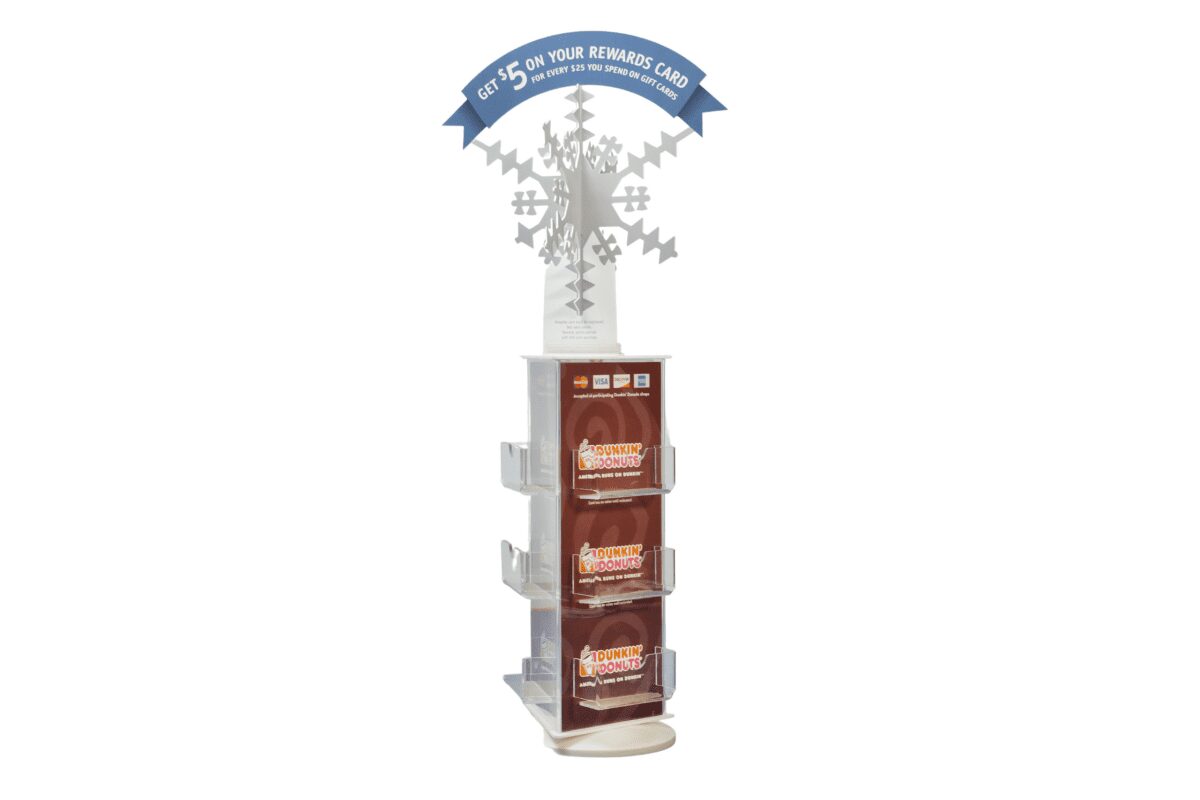
- POP and point-of-sale displays. Freestanding units, counter displays, and endcaps that hold product and messaging together. Best for launches and impulse categories near the register.
- Window and door graphics. Perforated films, clings, and cut vinyl that convert sidewalk traffic. Best for street-facing stores in walkable districts like Back Bay, Cambridge, and the North End.
- Standees and posters. Rigid, die-cut figures and printed posters that create a focal point in an aisle or entrance.
- Floor graphics. Durable, slip-rated films that direct movement and mark promotions on the floor itself.
- Fabric and SEG displays. Tension-fabric graphics on aluminum frames that give a premium, wrinkle-resistant look and swap out quickly. See the fabric and SEG display options.
- Environmental and wall graphics. Full-wall coverings that transform a space for a brand moment or a flagship interior, covered on the wall coverings page.
- Decals. Versatile branding and informational graphics for shelves, cases, and equipment.
The right mix depends on your store layout and goal. A single well-designed endcap can outperform a dozen scattered shelf tags, because it concentrates the message where the hand reaches for the product.
Materials and print methods that hold up in a retail environment
The right material depends entirely on where the graphic lives and how long it needs to last. A short-run window cling, a high-traffic floor graphic, and an outdoor sidewalk banner each call for a different substrate, ink, and finish. Getting that spec right is the difference between a display that looks sharp for a full season and one that peels or fades in weeks.
Print method is the first fork in the road. The two production paths behave differently:
| Factor | Digital printing | Screen printing |
|---|---|---|
| Best for | Short to mid runs, photographic and variable art | Large volumes, bold flat color |
| Detail | Up to 720 DPI photo-realistic output | Crisp solid colors, heavy ink lay-down |
| Setup | Minimal, fast turnaround | Higher setup, lower per-unit cost at volume |
| Substrates | Wide range, rigid boards up to 2 inches thick | Excellent on many rigid and flexible stocks |
Albert Basse Associates runs both, so the method is matched to the job rather than forced to fit one machine. The digital printing service uses large-format presses including the Durst P5 350 HS and the SwissQprint Nyala 4, prints on substrates up to 2 inches thick, offers white and clear inks for specialty effects, and reaches up to 720 DPI. For high-volume runs and bold, flat color work, the screen printing service delivers durable, saturated results at scale.
Durability is a spec, not a guess. On the digital side, standard output is rated for two to three years of outdoor durability, and up to five years with a protective laminate. That laminate matters for anything a shopper touches or steps on, such as floor graphics and counter wraps, where scuff and moisture resistance decide the lifespan. Indoor displays can use lighter, lower-cost substrates, while a street-facing window graphic in a New England winter needs films and adhesives built for temperature swings and repeated cleaning.
How to choose a retail display graphics partner in Boston
Choose a partner that can design, print, finish, and install under one roof, because every handoff between vendors adds a day and a chance for error. Albert Basse Associates has produced print and display work since 1928 as one of the longest continually operating, family-owned large-format digital and screen printers in the country, and it runs from 175 Campanelli Parkway in Stoughton, Massachusetts, roughly 20 miles south of downtown Boston. That proximity keeps proofs, press checks, and store installs on a local clock rather than a shipping schedule.
Look for four capabilities when you evaluate a shop:
- In-house prepress and design so files are built correctly for large format before they hit the press, avoiding the resolution and color surprises that show up at scale.
- Both print methods so digital and screen printing are chosen on merit, matched to run length, detail, and budget.
- Finishing and fulfillment so displays are cut, laminated, mounted, kitted, and shipped ready to set. Albert Basse handles this through its finishing and fulfillment service, which keeps multi-store rollouts consistent.
- A track record with real retail brands. Albert Basse has produced work for national retailers and brands including Stop & Shop, CVS, Reebok, Dunkin’, Adidas, Macy’s, and Staples, and it serves accounts across New England and nationwide.
Turnaround and communication round out the list. The team commits to responding to inquiries within 24 hours, which matters when a store reset date will not move. You can review the shop’s nearly century-long history or start a project through the contact page.
Frequently Asked Questions
What are retail display graphics?
Retail display graphics are large-format printed and mounted visuals used inside stores to promote products and guide shoppers. The category includes POP displays, window and door graphics, floor graphics, standees, posters, decals, wall and environmental graphics, and fabric (SEG) displays. Their job is to influence the purchase decision at the shelf, where most buying choices are still made.
How much do retail display graphics cost?
Cost depends on format, size, substrate, ink, quantity, and finishing. A short run of window clings is a very different quote from a multi-store POP display rollout with rigid substrates and installation. The most reliable way to budget is to share your dimensions, quantities, and install locations and request a quote, rather than relying on a generic price list.
What is the difference between digital and screen printing for retail displays?
Digital printing is ideal for short to mid-length runs, photographic detail, variable artwork, and fast turnaround, reaching up to 720 DPI. Screen printing is ideal for large volumes and bold, flat color, where its heavier ink lay-down and lower per-unit cost at scale become advantages. Many programs use both across different pieces in the same campaign.
How long do retail display graphics last?
Durability depends on material and placement. Standard large-format digital output is rated for two to three years of outdoor durability, and up to five years with a protective laminate. Indoor displays can last well beyond a single season, while high-touch pieces like floor graphics benefit from laminates that resist scuffing and moisture.
Can retail display graphics be installed in stores across Boston and New England?
Yes. Albert Basse Associates provides finishing, fulfillment, and installation and serves accounts throughout New England and nationwide from its Stoughton, Massachusetts facility. Displays can be produced, kitted, and shipped ready to set, or installed to keep a multi-location rollout consistent.
Retail display graphics remain one of the most direct ways to reach a shopper who is already in the room and already deciding. Match the format to the goal, spec the material to the placement, and work with a partner who can carry a project from design through installation. To scope a display program for your Boston store, reach out to the Albert Basse team.