Car Dealership Signage in Boston: Glass, the Lot and the Showroom

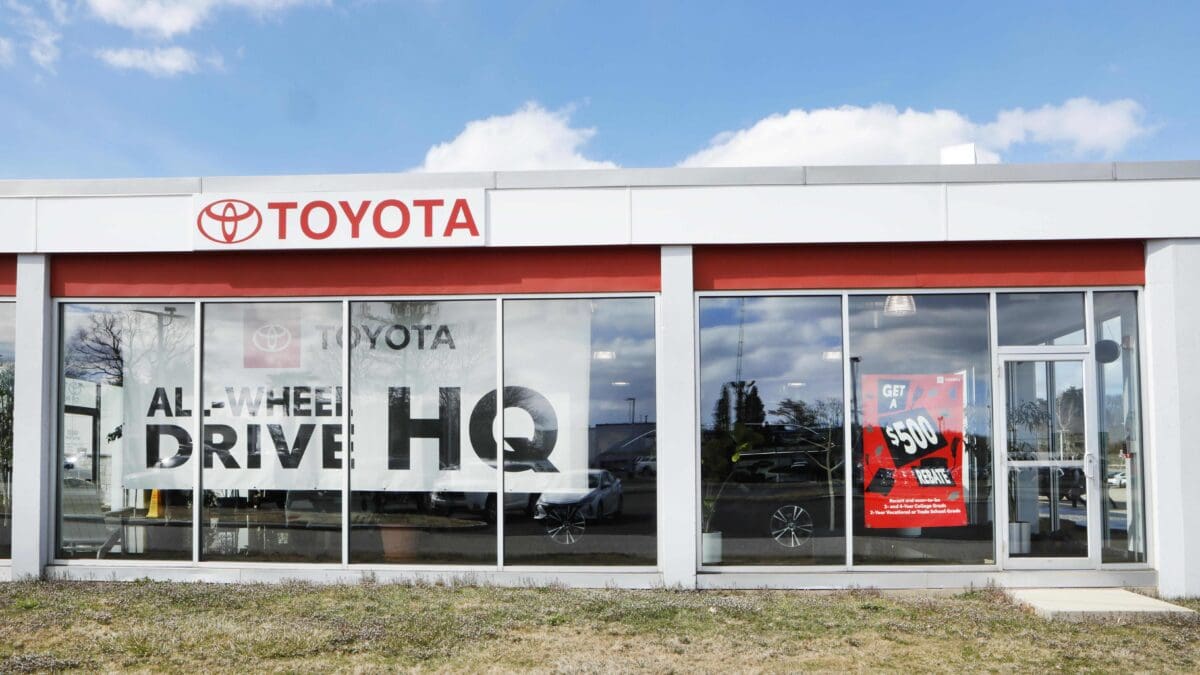
A car dealership asks print to do four unrelated jobs at once. The glass on the showroom front has to read from a road at 45 mph. The lot has to survive a New England winter. The showroom floor has to look like the brand’s national campaign. The service drive has to tell a person where to stop. Same logo, same color, four different lifespans.
Albert Basse Associates is a large-format digital and screen printing company in Stoughton, MA, working since 1928. The formats we list on our products pages — point of sale displays, signs, decals, indoor and outdoor banners, door and window clings, floor graphics, banner stands and standees, lawn and yard signs, and shelf and counter wraps — are the same formats a dealership orders. This is how they fit together on a single store.
The five surfaces a dealership prints on
Walk a dealership from the road inward and the print changes job at every step.
The showroom glass
The largest piece of advertising a dealership owns is its own window line. A graphic printed on the glass carries the model, the drivetrain message or the season, and it is seen before anyone reads the pylon sign. Glass graphics are printed as clings or applied vinyl and sized to the building, not to a stock sheet. The detail that matters is covered in our guide to window graphics in Boston.
The lot
Outside, print is fighting weather. Lot banners, drive-aisle flags and entrance signage are the pieces that get replaced, so material choice is a budget decision as much as a design one. Our breakdown of vinyl, mesh and fabric banner materials covers which one belongs on an exposed fence line, and feather, teardrop and blade flag shapes covers what reads from a moving car.
The showroom floor
Inside, the work is point of sale: model cards, spec boards, standees beside a vehicle, counter wraps at the sales desk. These are short-run pieces that change with the campaign, and they are the ones most likely to be ordered as a set for several rooftops at once.
The service drive
The service side is wayfinding plus durability. Lane numbers, check-in direction, waiting-area graphics and floor markings all take foot and vehicle traffic. Floor pieces in particular have their own material rules — see floor graphics in Boston.
The small compliance and information pieces
Window stickers, accessibility decals, hours-of-operation clings and parking markers are tiny orders that nobody plans for and everybody needs. They are die-cut custom decals, printed on the same presses as the large pieces.
Dealership glass is paneled, not printed in one piece
A showroom front is a row of glass bays separated by aluminum mullions. A graphic that spans five bays is not one five-bay sheet. It is five panels, each cut to its own bay, with the artwork split so the break lands on the mullion rather than through a letter.
That split is a prepress decision, and it is made before anything prints. Get it wrong and a word is cut in half by a two-inch aluminum post for the next three years. Get it right and the eye reads straight across the building.
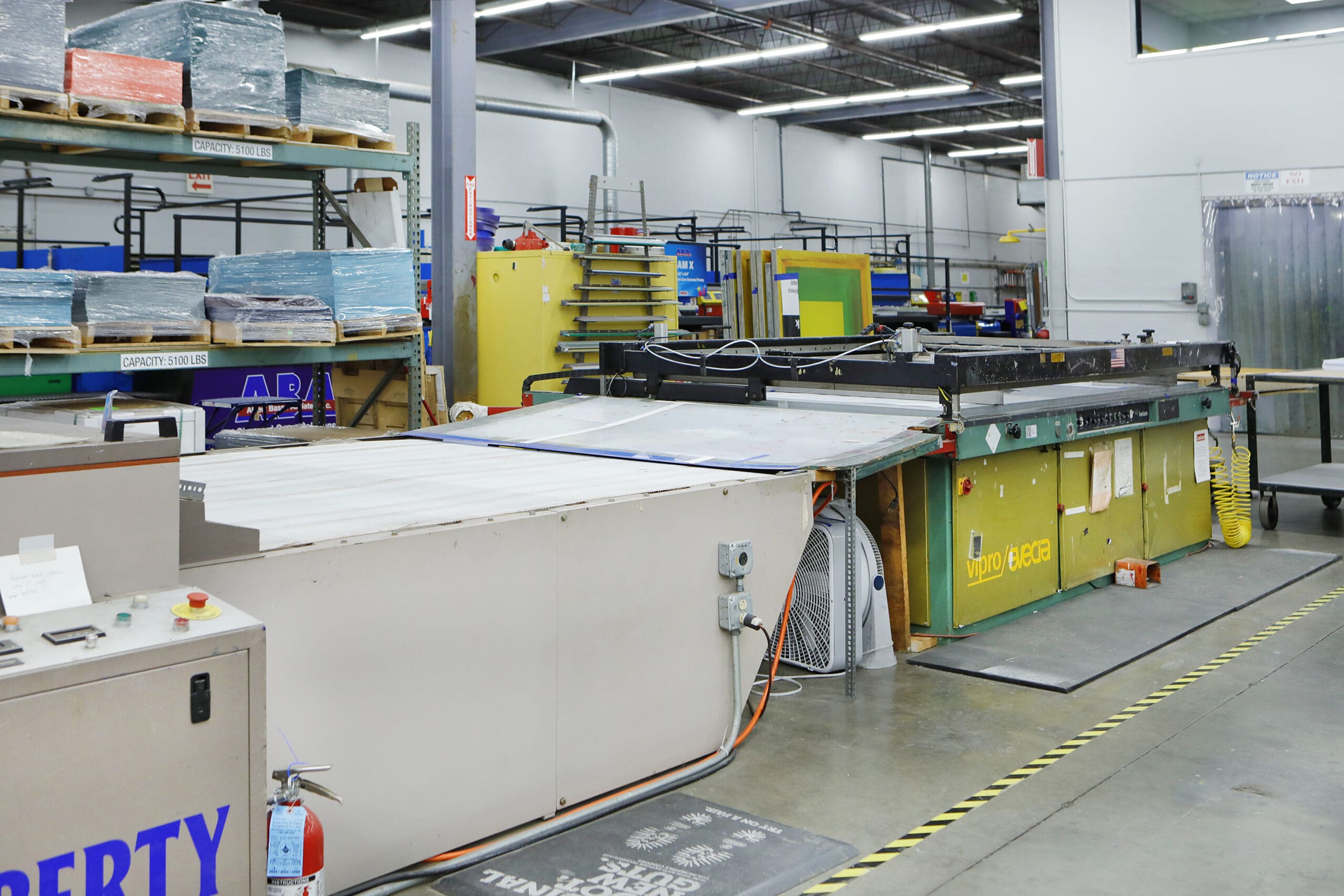
The equipment sets the panel limits. Our Durst P5 350/HS handles roll and board work up to 3.5 m. Flatbed cutting and routing runs on a 60" x 120" Zünd. Laminating and mounting go up to 60". Custom die cutting runs up to 37" x 55", with larger sizes handled as needed. Those four numbers, not the size of the building, decide where the panel breaks fall.
One practical consequence: tell us the mullion spacing, not just the overall width. A dealership front measured as "about 42 feet" produces a different panel plan than the same front measured bay by bay.
What the outdoor numbers mean for a lot
Material life is the figure that decides whether a dealership reorders lot graphics once a year or once every three. Our digital printing spec states outdoor durability of 2 to 3 years, or 5 years with laminate; prints up to 720 DPI; white and clear ink options; and materials up to 2" thick.
Read those as a planning tool. A lot banner that is coming down after a spring sales event does not need laminate. A dealer-group entrance sign meant to stay up until the brand refreshes does. The laminate roughly doubles the stated outdoor life, and it is the cheapest decision on the whole order to get right at the start.
The same logic applies to banner hardware. Whether a banner is hemmed, grommeted or finished with pole pockets changes how it behaves in wind long before the print fails — we cover that in banner finishing options, and we look at real-world life in how long outdoor banners last.
Keep the brand panel and the offer panel separate
Dealership messaging has two clocks. The brand message — the model line, the drivetrain claim, the store’s own positioning — changes once a year or less. The offer — the rebate, the APR, the event weekend — changes constantly, and it usually carries fine print and a date.
Printing both into one window graphic ties the slow message to the fast one. When the offer expires, the whole panel comes down, including the part that was still correct.
The fix is layout, not material. Give the offer its own bay, its own cling or its own poster panel, sized so it can be swapped without touching the rest of the run. The brand panels stay up. The offer panel is a small reprint. On a multi-rooftop group this is the difference between reprinting one panel and reprinting a storefront.
It also changes what you send to prepress. The brand artwork is built once at full panel size. The offer artwork is built as a template with the legal line and the date as editable fields, so the next version is a file swap rather than a redesign.
Screen or digital on a dealership order
Most dealership work splits cleanly. Long runs of an identical piece going to many rooftops — the same model card, the same window cling, the same counter wrap — favor screen printing. Short runs, store-specific panels and anything with a photograph favor digital.
Our screen presses produce spot PMS colors, fine line half tones and 4-color process. Ink options include UV spot and 100% clear coats and varnish, special effects, pearlescent and glitter, plus solvent-based metallic, neon, DayGlo, glow-in-the-dark and scratch-off. A scratch-off, in particular, is a dealership tool: a mailer or showroom card where the prize is revealed at the desk.
The full comparison, including where each process stops making sense, is in screen printing vs digital printing. The short version for a dealership: one piece in quantity, screen; many pieces in small quantity, digital; and a campaign that needs both runs on both, in the same building.
Holding one brand color across glass, fabric and board
A manufacturer’s red is the same red in the brand book and a different red on a gloss cling, a mesh lot banner and a matte foam board. The substrate changes what the ink does.
That is why a dealership campaign is proofed before it runs. We run contract digital proofing on an Epson Stylus Pro 9900 so a color is approved on paper before a press is tied up. Where a spot color is critical across several materials, the proof is the conversation. Pantone color matching across a campaign goes into which process holds a spot color and what to send so a reorder starts from the same place.
What to send before anything prints
Dealership artwork usually arrives from three directions at once: the manufacturer’s national campaign assets, the dealer group’s own brand files, and something the store made last year that everybody likes. Prepress is where those are reconciled.
Our prepress and design team works in Adobe Creative Cloud on Mac design and layout workstations, with 60" digital film output in house. Files can be uploaded straight to the prepress department from our prepress and design page.
What helps most:
- Bay-by-bay glass measurements, with mullion widths, not a single overall dimension.
- Vector logos and the specified PMS numbers, rather than a logo lifted from a web page.
- The legal line and expiry date for any offer, supplied as live text so it can be reset for the next version.
- Whether the piece is indoor or outdoor, and how long it needs to stay up — that single answer decides laminate.
- A note of which rooftops get which version, if the order covers more than one store.
Ordering for more than one rooftop
Dealer groups rarely order for one store. The same campaign lands at several locations with different window sizes, different lot layouts and different install dates, and the pieces still have to match.
That is a finishing and fulfillment problem more than a printing one. We handle grommeting, stitching, heat seal, assembly, precision cutting and trimming, guillotine cutting, laminating and mounting up to 60", custom display assembly, collating and packaging, and nation-wide drop shipping via UPS, FedEx and others. We also keep a wide assortment of display hardware and fixtures in stock, which matters when a standee or banner stand has to arrive complete rather than as parts.
Packed per store, labeled per store, shipped per store: the install crew at each rooftop opens one box that contains only their panels. Our note on national rollouts covers how that sequencing works on larger programs.
- Measure dealership glass bay by bay, including mullion widths, so panel breaks fall on the aluminum and not through a word.
- Laminate is the decision that turns 2 to 3 years of outdoor life into 5.
- Give the offer its own panel so an expired rebate does not take down a brand message that is still correct.
- Long runs of one identical piece suit screen printing; store-specific and photographic pieces suit digital.
- For a group, ask for the order packed and labeled per rooftop, not as one bulk shipment.
Printing dealership graphics in Massachusetts and New England
We work primarily with clients across New England and serve customers throughout the Northeast, including Massachusetts, Rhode Island, Connecticut and New Hampshire, from our plant at 175 Campanelli Parkway in Stoughton, MA. Screen printing, digital printing, prepress and design and finishing and fulfillment all happen in the same building, which is what keeps a window panel, a lot banner and a showroom standee reading as one campaign.
Tell us which surfaces are in scope, how long each piece needs to last and how many rooftops it covers. Complete our contact form and we will respond within 24 hours to discuss your project.
Contact Albert Basse Associates · (781) 344-3555 · Stoughton, MA
Related reading: banners and flags, screen printing, and window graphics in Boston.