POP Displays: A Boston Buyer’s Guide to Point-of-Purchase

A POP display is a printed or fabricated fixture that promotes a specific product or offer at the exact spot where a shopper decides to buy: the endcap, the counter, the shelf, or the floor. It puts a brand message in front of a customer at the moment attention and intent overlap, which is why consumer-goods companies keep funding displays even as media budgets shift online. This guide covers what POP displays are, the formats and materials that fit each retail job, how they get produced, and how to tell whether one is earning its keep. It is written from the workshop floor of a family-owned Boston-area printer that has built these fixtures since 1928.
Key Takeaways
- E-commerce was only 16.9% of total U.S. retail sales in the first quarter of 2026, so more than 80 cents of every retail dollar is still spent in physical stores where POP displays live (U.S. Census Bureau).
- A 2026 field study in the Journal of Marketing measured an 8.1% lift in the likelihood of buying a featured product from in-store signage, across roughly 30 million shoppers (Journal of Marketing / VU Amsterdam).
- Common formats include endcaps, floor displays, counter units, pallet displays, standees, and fabric SEG displays, each matched to a material and a durability target.
- A production partner that handles design, printing, finishing, and kitting under one roof shortens timelines and keeps multi-store rollouts consistent.
What is a POP display, exactly?
A POP (point-of-purchase) display is any in-store fixture built to sell one product or promotion at the place a shopper is ready to act. Despite a decade of online growth, most buying still happens in person. E-commerce accounted for just 16.9% of total U.S. retail sales in the first quarter of 2026, which leaves better than four out of five retail dollars spent in physical space, according to the U.S. Census Bureau. That physical space is enormous: advance retail and food-services sales hit $768.6 billion in June 2026 alone, up 6.7% from a year earlier (U.S. Census Bureau).
People sometimes use POP and POS interchangeably. POP (point of purchase) refers broadly to any spot in the store where a product meets a shopper. POS (point of sale) is narrower: the checkout, where counter displays and impulse racks live. Both are printed and fabricated the same way. The difference is location and intent, not production.
Do POP displays still work in 2026?
Yes, and both survey data and sales data support it. In a January 2026 survey of 1,119 U.S. shoppers commissioned by display manufacturer Frank Mayer, 92% said they sometimes or regularly buy items they did not plan to, and more than 60% said an in-store display had swayed their choice between similar products (VMSD). Because that survey was paid for by a display maker, treat it as directional rather than neutral, but the direction matches independent research.
The hard numbers come from a 2026 Journal of Marketing field study covering 237 advertising campaigns and about 30 million shoppers. In-store digital signage raised the likelihood of purchasing a featured product by 8.1%. That study measured digital screens rather than printed board, so read it as proof that a message at the point of purchase moves sales, not as a number for cardboard specifically. Brands clearly believe it: in the Path to Purchase Institute’s 2024 trends survey, 87% of consumer-product organizations said they invest in temporary in-store displays and 55% in permanent ones (Path to Purchase Institute).
In-store impact
What shoppers do in front of a display
Survey and field-study evidence on point-of-purchase displays.
Frank Mayer / VMSD survey, Jan 2026 (n=1,119); Journal of Marketing field study, 237 campaigns / ~30M shoppers; AV Magazine.
The main types of POP displays
Floor displays are the workhorse of the category. They held 43.15% of the global POP display market in 2025, per Mordor Intelligence, which sized that market at $16.27 billion and projects it to reach $22.23 billion by 2031. The right format depends on where the shopper meets the product and how long the piece needs to survive.
| Format | Where it lives | Typical material | Best for |
|---|---|---|---|
| Endcap | End of an aisle | Corrugated, foam board | Featured promotions, seasonal pushes |
| Floor display | Open floor, high traffic | Corrugated, corrugated plastic | Product launches, bulk stacks |
| Counter display | Checkout and counters | Rigid board, acrylic | Impulse items, small goods |
| Pallet display | Warehouse-club floors | Heavy corrugated | High-volume, ship-ready loads |
| Standee | Entrances, aisles | Rigid board, foam | Brand characters, announcements |
| Shelf and dangler | On or above the shelf | Styrene, card stock | Navigation, on-shelf callouts |
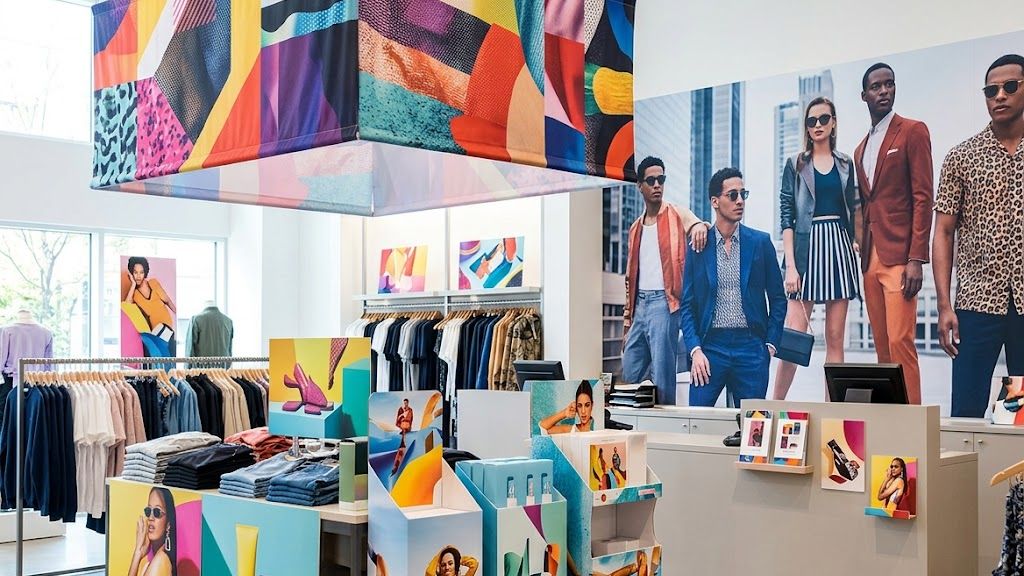
| Fabric SEG display | Boutiques, flagships | Fabric on aluminum frame | Premium, reusable, backlit looks |
Not every job needs a floor unit. A boutique on Newbury Street may want a backlit fabric frame that reads as part of the fixtures, while a warehouse club wants a pallet skirt that ships pre-packed. Matching the format to the environment is half the work.
Which materials should you choose?
Demand for these fixtures is outpacing the broader display category, which raises the stakes on material choice. Global Market Insights valued the retail displays market at $16.5 billion in 2023 and named point-of-purchase displays the fastest-growing segment, expanding at more than 7.5% a year. The material you pick decides how long that spend lasts.
- Corrugated cardboard. Lightweight and cost-effective, ideal for temporary promotions measured in weeks. Easy to flat-pack and ship.
- Corrugated plastic (Coroplast). More moisture and scuff resistant than cardboard, a good middle ground for displays that need to hold up for a season.
- Foam board and rigid styrene. Clean, flat surfaces for standees and shelf signs.
- Acrylic and metal. Premium and reusable. Acrylic reads as high clarity; metal frames survive years of handling.
- Fabric over SEG (silicone edge graphic) frames. Ultra-sharp dye-sublimation print on tensioned fabric that snaps into an aluminum frame with no tools. Graphics swap in minutes, so the same structure can carry a new campaign.
Durability tracks the material and the finish. Standard large-format digital output rates two to three years of outdoor durability, and up to five years with a protective laminate, which is why high-touch pieces get laminated for scuff and moisture resistance. For the design principles that make any of these materials perform, see our breakdown of the five keys to high-converting POP displays.
How POP displays get made in a Boston print shop
Turning a concept into a fixture on a store floor runs through a predictable sequence, and the shop that owns every step controls the timeline. The work moves through four stages.
Prepress and design. Files are built and checked for large format so color, bleed, and structure hold at full size. Getting this right up front is what prevents a reprint later.
Printing. Wide-format digital printing handles photographic detail at up to 720 DPI, with white and clear ink options and the ability to print rigid material up to two inches thick. Hybrid roll-and-board presses run graphics up to 3.5 meters wide, so a floor display and its header can come off the same line. For bold, flat, high-volume color, screen printing is often the more economical route. Many displays combine both.
Finishing and fulfillment. This is where a display becomes ship-ready. Pieces are cut, laminated, mounted, kitted, and shipped ready to set, or installed on site. Our finishing and fulfillment team also warehouses and ships to store lists, which matters when a program spans dozens of locations. For premium reusable structures, we build fabric and SEG displays as an authorized Matrix Frame dealer.
Rollout coordination. A single retailer test is one thing. A national reset across hundreds of doors is another. Consolidating design, production, kitting, and distribution under one roof keeps every store’s display identical and on schedule. We respond to project inquiries within 24 hours so a program does not stall at the quoting stage.
How to measure whether a POP display paid off
Measure the lift, not the impression. The Journal of Marketing field study cited above put the average sales lift from in-store signage at 8.1%, and trade coverage of the same research noted that new-product launches approached a 25% lift (AV Magazine). Your own numbers matter more than any benchmark, so build measurement into the program from the start.
Three practical yardsticks:
- Sell-through per store. Compare units sold during the display period against the same weeks without it. Run a few control stores with no display if you can.
- Incremental margin against display cost. A display that lifts sales but erodes margin through discounting may not be worth repeating.
- Dwell and engagement. For flagship and boutique environments, time spent at the fixture is a leading signal that the creative is working before the sales data lands.
A display that cannot be measured is a guess. One that can be measured becomes a repeatable play.
Getting POP displays made in Boston and New England
Local production shortens the loop between proof and press. Albert Basse Associates runs from 175 Campanelli Parkway in Stoughton, Massachusetts, roughly 20 miles south of downtown Boston, and serves retail from Newbury Street boutiques and Seaport flagships to the suburban mall anchors ringing Route 128, plus Back Bay, Cambridge, and the North End. We have printed displays and in-store graphics for brands including Stop & Shop, CVS, Reebok, Dunkin’, Adidas, Macy’s, and Staples. For a deeper look at how we approach the local market, read retail display graphics in Boston, or contact our team at (781) 344-3555 to scope a project.
Frequently Asked Questions
What is the difference between POP and POS displays?
POP (point of purchase) covers any in-store location where a product meets a shopper, from aisle endcaps to floor units. POS (point of sale) is the checkout specifically, home to counter displays and impulse racks. POS is a subset of POP. Both are produced with the same printing and fabrication methods.
What is the most common POP display material?
Corrugated cardboard is the most widely used because it is lightweight, cost-effective, and easy to flat-pack and ship, which suits the temporary promotions that make up most display runs. Corrugated plastic, acrylic, metal, and fabric on SEG frames are chosen when a display needs more durability or a premium finish.
How long do POP displays last?
It depends on material and finish. Standard large-format digital graphics rate two to three years of outdoor durability, and up to five years with a protective laminate. A temporary cardboard promotion is built to run for weeks, while a laminated or metal-framed fixture is built to be reused across campaigns.
How long does it take to produce a POP display?
Timelines vary with quantity, material, and finishing, but the biggest variable is how quickly design files are approved. A shop that keeps prepress, printing, finishing, and fulfillment in one building can compress the schedule. Albert Basse responds to project inquiries within 24 hours to keep quoting from becoming the bottleneck.
Can one printer handle a national display rollout?
Yes, when design, printing, finishing, kitting, and distribution are consolidated under one roof. That consolidation is what keeps every store’s display identical and delivered on schedule. Albert Basse has produced national rollouts from a single Massachusetts facility for large retail brands.
How do I know if a POP display worked?
Compare sell-through during the display period against a baseline, ideally with a few control stores that had no display, and weigh the incremental margin against what the display cost. For flagship spaces, dwell time at the fixture is an early read on whether the creative is landing.
About Albert Basse Associates. Founded in 1928 and now in its third generation of family ownership, Albert Basse Associates is one of the longest continually operating large-format digital and screen printers in the nation. Based at 175 Campanelli Parkway, Stoughton, MA 02072, the company serves retailers and brands across Greater Boston, New England, and the Northeast with design, printing, finishing, and fulfillment under one roof. Reach the team at (781) 344-3555 or info@albertbasse.com.