
Printing on Corrugated Plastic: A Boston Spec Guide

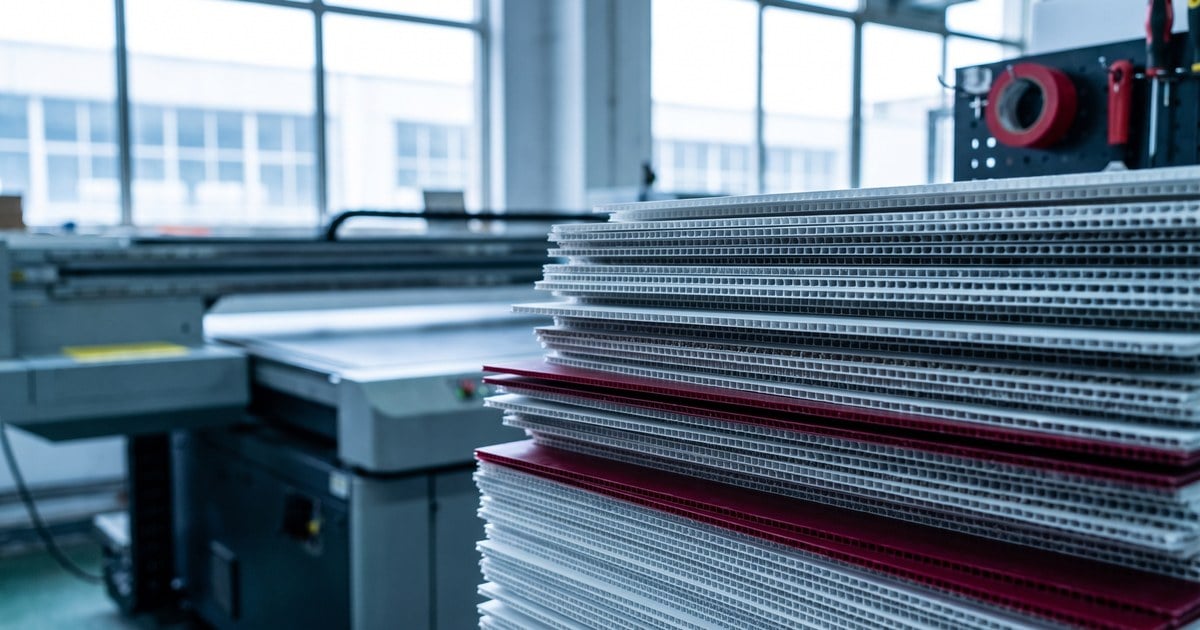
Printing on corrugated plastic means putting durable, weatherproof graphics directly onto a fluted polypropylene board, and the method you choose decides how sharp, how tough, and how affordable the finished sign turns out. There are three real ways to do it: direct ultraviolet (UV) flatbed printing, screen printing, and printing on adhesive vinyl that gets mounted to a blank sheet. Each one suits a different run size, budget, and level of detail.
At Albert Basse Associates, a family-run digital printing shop in Stoughton, Massachusetts since 1928, we print corrugated plastic on flatbed and hybrid presses that lay ink straight onto boards up to two inches thick. This guide covers the substrate itself, the three print methods, flute direction, thickness, durability, and file prep, so you can order the right sign the first time.
Key Takeaways
- Corrugated plastic is fluted polypropylene (resin code 5). Its low-energy, non-porous surface is why ink adhesion, not the print itself, is the real engineering problem.
- UV flatbed printing wins for photographic, short-to-mid runs; screen printing wins for high-volume, simple 1 to 3 color jobs; mounted vinyl covers specialty finishes.
- Flute direction is not cosmetic. It controls rigidity and whether a wire H-stake will even slide into the sign, so it must be specified before cutting.
- Standard thicknesses run 4mm, 6mm, and 10mm. Outdoor life is roughly 2 to 3 years, or up to 5 years with a UV laminate.
- As a single-material polypropylene board, unlaminated corrugated plastic is recyclable wherever number 5 plastic is accepted.
What is corrugated plastic, and why does the surface fight the ink?
Corrugated plastic is an extruded twin-wall sheet: two flat polypropylene liners bonded by a row of vertical ribs, called flutes, running through the middle. You may know it by trade names like Coroplast, Coreflute, or IntePro. It is light, waterproof, chemical-resistant, and it will not warp, rot, or swell the way cardboard or untreated wood does outdoors. That toughness is exactly why it dominates yard signs, real estate riders, and point-of-purchase displays.
The catch is chemistry. Polypropylene is a low-surface-energy, non-porous plastic, so ordinary inks bead up and flake off instead of keying into the material the way they do on paper. Printers get around this three ways: UV-curable inks blended with adhesion promoters that harden instantly under UV-LED lamps, a surface pre-treatment (corona or flame treatment) that raises the sheet’s surface energy so ink wets out and bonds, or printing on adhesive vinyl and laminating that onto a blank board. Understanding that adhesion problem is what separates a sign that survives a New England winter from one that peels by spring. For the broader product overview, see our complete guide to Coroplast signs and custom rigid printing.
Which printing method belongs on corrugated plastic?
The U.S. printing industry still employs roughly 338,500 people across about 27,291 establishments as of 2026, according to the Bureau of Labor Statistics, and those shops split corrugated plastic work across three distinct processes. Picking the right one is mostly a question of how many pieces you need and how detailed the artwork is.
Direct UV flatbed printing (digital). The board is laid flat on a vacuum bed and printheads lay CMYK ink, plus white and clear, straight onto the sheet while UV-LED lamps cure it on contact. Our SwissQprint Nyala 4 flatbed and Durst P5 350/HS hybrid handle rigid boards this way at up to 720 DPI. This is the method for full-color photographs, gradients, variable data, and short-to-mid runs, because there are no screens or plates to set up. White ink also lets you print bright graphics on colored or clear stock.
Screen printing. Ink is pushed through a stencil mesh, one screen per color. It carries a setup cost for each color, so it is not built for photographs, but at volume it is hard to beat. For a real estate brokerage ordering two thousand identical two-color signs, screen printing delivers thick, opaque, weather-stable ink and the lowest per-piece cost. Simple, bold, high-count jobs are its home turf.
Print-and-mount vinyl. Here the graphic is printed on adhesive vinyl, often laminated, then applied to a blank corrugated plastic board. It is useful for specialty finishes or an extra protective layer, though it adds material, labor, and a small risk of edge lift over time.
| Method | Best run size | Detail level | Cost driver |
|---|---|---|---|
| UV flatbed (digital) | 1 to a few hundred | Photographic, full color | Per-square-foot print time |
| Screen printing | Hundreds to thousands | Simple 1 to 3 colors | Per-color screen setup |
| Mounted vinyl | Any, specialty finishes | Photographic, plus laminate | Vinyl, lamination, labor |
Why does flute direction change the whole sign?
Flute direction is the single spec most buyers forget, and it quietly wrecks more signs than any color mismatch. The flutes are hollow channels that run one way through the sheet, and they control three things at once: the board is stiffer across the flutes than along them, the sheet scores and folds cleanly only along the flute lines, and, most importantly, a wire H-stake can only slide into the sign if the flutes run in the same direction as the stake legs.
Picture a classic staked lawn sign. The stake pushes up from the ground into the bottom edge, so the flutes have to run vertically, top to bottom. Order that same sign with the flutes running side to side and the stake has nowhere to go, and the sign flops. Always tell your printer the finished orientation and how the sign will be mounted, so the sheet is cut with the flutes running the right way. It costs nothing to specify and everything to get wrong.
How thick should the corrugated plastic be?
Thickness is measured in millimeters, and the common options are 4mm, 6mm, and 10mm, with thinner 2mm and 3mm stock available for lightweight indoor use. The right pick balances rigidity against weight and cost.
- 4mm is the workhorse. It suits yard signs, real estate signs, wayfinding, and light point-of-purchase pieces, and it is what most people picture when they think of a coroplast sign.
- 6mm and 10mm add stiffness for larger formats, freestanding displays, and signs that must stand up to wind or handling without a frame. More material means more rigidity, more weight, and a higher price.
If a sign will be mounted flush to a wall or a fence, thinner stock is fine. If it has to span a wide opening, cantilever off a single stake, or stand on its own, step up the thickness. Our prepress team will flag the right gauge once we know the size and how the piece gets installed.
Spec guide
Corrugated plastic thickness, and what each one is for
Thickness is the first decision: it sets rigidity, wind tolerance, and whether the sign needs a frame.
lightweight indoor use
indoor signs and short runs
the workhorse: lawn and real estate signs
larger formats and wind exposure
freestanding displays with no frame
How long does printed corrugated plastic last outdoors?
Printed corrugated plastic holds up well outdoors: we rate our UV-printed boards at roughly 2 to 3 years of outdoor life, or up to 5 years with a protective UV laminate. Because the substrate is polypropylene, the board itself is waterproof and shrugs off the freeze-thaw cycles, road salt, and coastal damp that define a Massachusetts year. The variable is the ink, not the sheet.
UV-cured inks are inherently UV-stable, which is why they resist fading better than many older solvent systems. For a short-term promotion, an election cycle, or an open house, unlaminated stock is plenty. For signage that has to look crisp through multiple New England summers, a UV laminate is the upgrade that pays for itself. Lamination also adds scuff resistance for signs that get handled, stacked, or transported often.
Is corrugated plastic recyclable?
Corrugated plastic is polypropylene, resin identification code 5, and an unlaminated board is a single, clean material, so it is recyclable wherever number 5 plastic is accepted. That matters more than it used to. The Environmental Protection Agency reports that plastics reached 35.7 million tons, about 12.2 percent of municipal solid waste, at just an 8.7 percent recycling rate in its most recent detailed figures, so keeping signage out of the landfill takes deliberate choices.
A few help. Choose a mono-material board and skip lamination when recyclability outranks longevity. Reuse and restake signs across campaigns instead of reprinting. Ask about recycled-content stock. None of this compromises print quality; it just keeps a durable material in circulation instead of the trash.
Where does printed corrugated plastic work best in Boston?
Physical retail still drives the demand. E-commerce made up only 17.1 percent of total U.S. retail sales in the second quarter of 2026, on total retail sales of about $1,986.5 billion, according to the U.S. Census Bureau, which means the large majority of shopping still happens in stores that need signage. Broader retail and food-services sales ran near $763.6 billion in July 2026, and every one of those storefronts is a candidate for point-of-purchase graphics.
Around Boston and across New England, we see printed corrugated plastic show up as real estate and open-house signs, political and election signage, retail aisle and point-of-purchase displays, event and directional signs, construction and job-site boards, and restaurant A-frame inserts. It is the default when a business needs many affordable, weatherproof signs fast. When durability outranks price, compare it against heavier-duty retail signage materials before you decide.
How to prepare files for corrugated plastic
Good print starts with a good file. Supply vector artwork or high-resolution raster at full size, build it in CMYK, and add bleed so the image runs cleanly to the trimmed edge. Keep critical text and logos inside a safe margin, well clear of any stake holes, grommets, or drill points. Tell us the finished dimensions, the flute orientation, and how the sign mounts, because those three details drive how the sheet is cut. If you are printing on colored or clear stock, ask about a white-ink layer so the colors stay bright.
Not sure which method or thickness fits your project? Contact our Stoughton shop and we will spec it with you.
Frequently Asked Questions
Is corrugated plastic the same as Coroplast? Coroplast is a widely used brand name for corrugated plastic, the way people say the trademark instead of the material. Coreflute and IntePro are other common names. They all describe the same fluted polypropylene twin-wall sheet.
Can you print full-color photos on corrugated plastic? Yes. UV flatbed printing lays photographic, full-color images directly on the board at up to 720 DPI, including white ink for prints on colored or clear stock. Screen printing is better for simple, high-volume designs rather than photographs.
Which way should the flutes run on a yard sign? Vertically, top to bottom, so a wire H-stake can slide up into the flutes from the bottom edge. Tell your printer the sign will be staked so the sheet is cut correctly.
How thick should a yard sign be? For standard lawn and real estate signs, 4mm corrugated plastic is the usual choice. Step up to 6mm or 10mm for larger, freestanding, or high-wind signs that need extra rigidity.
Does corrugated plastic fade in the sun? UV-cured inks resist fading, and boards last roughly 2 to 3 years outdoors, or up to 5 years with a UV laminate. For long exposure, laminate the sign.